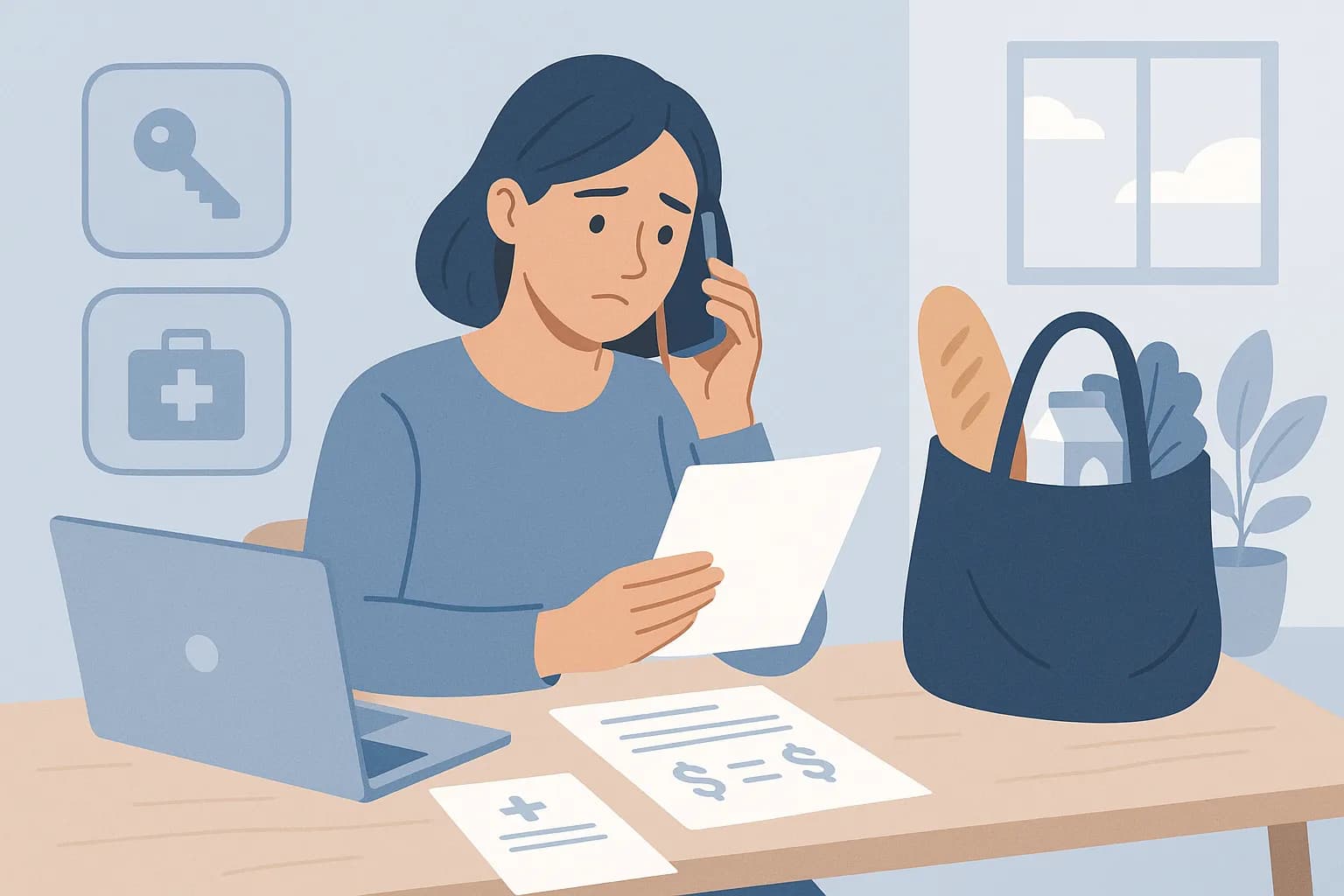
Why most people miss out on help they're owed
The programs exist. The money exists. What fails most people is timing and awareness. You don't hear about SNAP or Medicaid because nobody schedules that meeting when you get your pink slip.
Losing a job is one of the most disorienting things that can happen to a person financially. One week you have a paycheck, a routine, and a plan. The next week you're staring at a stack of bills and wondering which one to pay first. Here's the thing: the U.S. has a surprisingly robust web of programs designed for exactly this moment. The problem is that nobody hands you a roadmap when you clean out your desk. Most people leave money and benefits on the table simply because they don't know what exists or where to start. This guide is that roadmap.
How to file for Unemployment Insurance without losing weeks
File the day you lose your job, not after savings run out. Every week you wait is a week of potential benefits gone forever, because UI doesn't backpay more than a week or two in most states.
Unemployment Insurance (UI) is the most well-known support for job loss, but a lot of people wait too long to file or assume they won't qualify. File the moment you lose your job, not after you've burned through savings. Every state administers its own UI program under federal guidelines. Benefits typically replace 40 to 50 percent of your prior wages, up to a state-set weekly maximum. Most states pay benefits for up to 26 weeks, though extended benefits can kick in during economic downturns. The U.S. Department of Labor's CareerOneStop website lets you find your state's program in under a minute.
Eligibility for UI requires that you were let go through no fault of your own, that you worked enough hours in a defined base period (usually the first four of the last five completed calendar quarters), and that you are able and available to work. If you were fired for cause or quit voluntarily, qualification becomes harder but not always impossible. Some states allow claims if you quit due to documented unsafe conditions or domestic abuse. Honest answer: if you're on the fence about whether you qualify, file anyway. The worst outcome is a denial, and you can appeal that.
What documents do you actually need to apply?
Gather your Social Security number, employer contact info, wage history, and bank details before you open any application portal. State systems time out, and partial applications usually don't save.
To file for UI, you'll need your Social Security number, your employer's name and address, dates of employment, your reason for separation, and wage information for the prior 18 months or so. Some states also ask for your bank routing number for direct deposit setup. Gather these before you sit down to apply online, because most state portals time out and don't save progress well. Once you file, expect a one to three week waiting period before your first payment, plus a mandatory one-week unpaid waiting period in most states. File weekly certifications on time or your payments stop.
SNAP and food assistance: who qualifies and how fast?
If your income just dropped to near zero, you likely qualify for SNAP. Emergency cases can be processed within seven days, so don't assume you have to wait weeks for food help.
SNAP (Supplemental Nutrition Assistance Program) is what used to be called food stamps, and if your income just dropped to zero or near zero, you may qualify faster than you think. Income limits for SNAP are set at 130 percent of the federal poverty level for gross income, with most households also subject to a net income test after deductions. A single adult with no income will almost certainly qualify. The program is run by USDA but administered by your state, so apply through your state's SNAP agency or Benefits.gov. Most states now allow online applications, and many process emergency cases within seven days.
Health coverage after a job: COBRA vs. ACA marketplace
COBRA keeps your old plan but costs a lot. For most people who just lost income, ACA marketplace plans with premium tax credits will be cheaper. Run the numbers before you default to COBRA.
For health coverage, job loss is a qualifying life event that opens a Special Enrollment Period (SEP) on the ACA marketplace. You have 60 days from the date you lose job-based coverage to enroll. If your income drops below a certain threshold (generally 100 to 138 percent of the federal poverty level, depending on whether your state expanded Medicaid), you may qualify for Medicaid instead, and Medicaid has no enrollment window. You can apply any time. The key document here is proof of loss of coverage, which your former employer should provide. Don't let the 60-day SEP window close on you. It resets to zero once it expires.
COBRA lets you keep your former employer's health insurance for up to 18 months after leaving a job, but the cost is steep. You pay the full premium, including the share your employer used to cover, plus a 2 percent administrative fee. That can easily run $500 to $700 or more per month for an individual, and considerably more for a family. Honest assessment: for most people who just lost income, COBRA isn't the right move unless you have significant ongoing care needs or are very close to meeting your deductible. ACA marketplace plans with premium tax credits are often cheaper. Run the numbers on both before you decide.
Rental and utility help: where to look and who to call
Local programs are often your fastest option for rent and utility help. Start with 211.org and your county's housing authority, because federal dollars flow through local agencies and aren't always advertised online.
Rental assistance has expanded considerably since the pandemic. The Emergency Rental Assistance Program (ERAP) provided federal funds to states and localities, and while the original appropriations are largely spent, many areas still have active programs or waitlists worth joining. Separately, HUD's Emergency Solutions Grants (ESG) fund local nonprofits that provide short-term rental assistance. Start at HUD.gov or 211.org to find what's available in your county. Some local housing authorities also have one-time emergency funds that aren't well advertised. Call them directly and ask. The worst they say is no.
The Low Income Home Energy Assistance Program (LIHEAP) helps with heating and cooling bills, which can be a lifeline if you lose your job mid-winter. Eligibility is based on income and household size, and benefits are distributed through state and local agencies. Apply early in the heating season because funds run out. Similarly, the Universal Service Fund's Lifeline program subsidizes phone and internet service for low-income households, providing a discount of up to $9.25 per month (or up to $34.25 per month on tribal lands). In a job search, a working phone and internet connection aren't luxuries. They're tools. Don't let them lapse.
Your step-by-step action plan for the first two weeks
The order matters here. Unemployment first, then SNAP and health coverage, then local rental and utility help. Document every application number and deadline or the system will lose you in the shuffle.
Your next steps are simple, but the order matters. File for unemployment today, even if you're not sure you qualify. Then check SNAP eligibility at Benefits.gov. Open a marketplace account at HealthCare.gov and compare plans before your 60-day window closes. Call 211 for local emergency rental and utility help. And document everything: application confirmation numbers, denial letters, appeal deadlines. The system is navigable, but it rewards people who follow up and keep records. One missed certification or expired deadline can mean weeks without income. Set calendar reminders. Treat this like a part-time job until you're covered.


