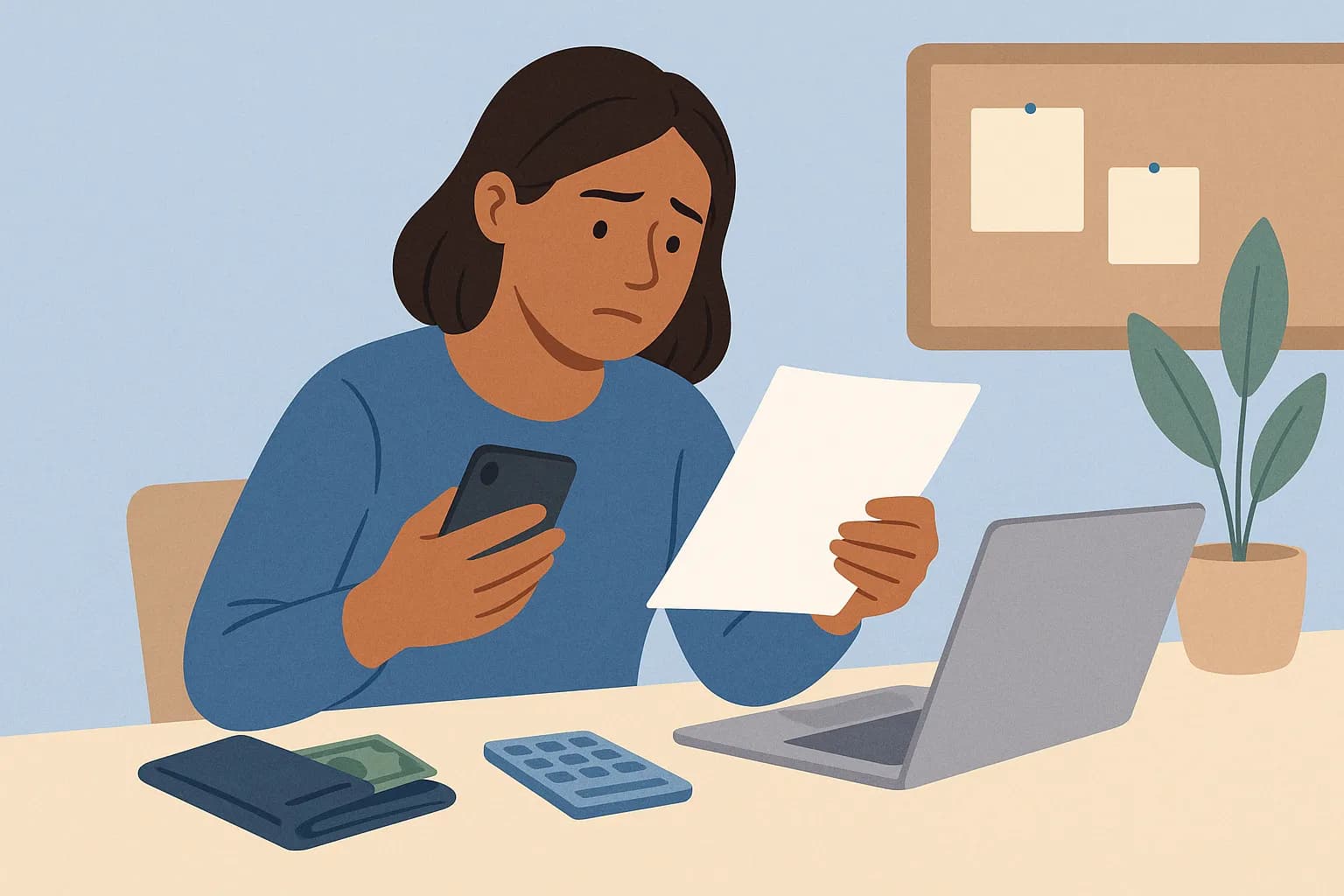
The first 30 days determine everything
Job loss doesn't ruin your finances on day one. It's the weeks of inaction that do the real damage. Move fast on unemployment, budgeting, and bill calls, and you can hold the line.
Job loss hits like a cold wall. One day you have a paycheck; the next, you're staring at a benefits portal wondering what 'base period wages' even means. Here's the thing: the financial damage from job loss isn't usually what happens in week one. It's what happens in weeks four through twelve, when savings erode, credit card balances creep up, and small missed payments start leaving marks. The good news is that the first 30 days are the window. Move fast and deliberately during this stretch, and you can stabilize your cash flow before anything becomes irreversible.
How do you file for unemployment and how much will you get?
File the same week you lose your job, full stop. States replace roughly 40 to 50 percent of prior wages, but caps vary widely, so look up your state's calculator before you make any assumptions.
Your first financial move after losing a job is to file for unemployment insurance. File the same week you lose your job, not after you've found another. Most states impose a waiting week before benefits begin, so every day you delay is money left behind. Benefits vary by state, but the U.S. Department of Labor reports that state programs replace roughly 40 to 50 percent of prior wages, subject to a weekly maximum that varies widely by state. California's maximum weekly benefit is around $450 to $1,300 depending on earnings; Texas caps at roughly $563. Look up your state's wage replacement calculator before you assume the check will cover your rent.
When you file, states look at your 'base period,' which is typically the first four of the last five completed calendar quarters before you filed. You'll need your employer's name and address, your dates of employment, and your gross wages. Have your Social Security number and direct deposit information ready. The online portals are clunky but workable. If your application is denied, appeal immediately. The CFPB and state workforce agencies note that a meaningful share of denials are overturned on appeal, often because the initial review flagged a technicality rather than a substantive disqualification.
Build an emergency budget, not a trimmed normal budget
An emergency budget is a triage document. Cut everything that isn't shelter, food, utilities, or transportation, then look hard at what's left for flex. This is not the time to be sentimental about subscriptions.
An emergency budget is not your normal budget with a few expenses crossed out. It is a triage document, and it needs to be built in two passes. The first pass: list every single recurring charge hitting your bank account or credit cards. Subscriptions, gym memberships, streaming services, cloud storage, annual renewals. Cancel or pause everything that isn't shelter, food, utilities, or transportation to work (or to job searching). The second pass is harder: look at the fixed expenses you can't cancel and figure out which ones have flex. Many lenders and servicers offer hardship programs that most people never call about.
Which bills should you pay first when money is short?
Housing first, utilities second, food third, transportation fourth. Everything else waits. The consequences of nonpayment are not equal, and treating them as if they are is a costly mistake.
Prioritize your bills in this order: housing first, utilities second, food third, transportation fourth, and everything else after. This isn't a matter of opinion; it reflects the consequences of nonpayment. Miss a mortgage payment and you're months from foreclosure. Miss a credit card payment and you get a fee plus a ding on your credit report. Those aren't equivalent outcomes. Federal student loans have built-in income-driven repayment and deferment options. Contact your servicer early. Medical bills are almost universally negotiable after the fact. Letting them go to collections is a mistake; calling the billing department and asking for a hardship reduction or payment plan often works.
Where can you find short-term cash without wrecking your future?
Tap your emergency fund first, then look at credit union loans or 0% APR credit card offers. Payday loans are a trap I'd avoid entirely. Retirement accounts should be close to last resort.
Short-term liquidity is the gap between your first unemployment check and your current bank balance. Here's what I'd prioritize, in order. First, your own emergency fund if you have one. Use it. That's what it's for. Second, any cash value in a whole life insurance policy, which you can borrow against without a credit check or tax consequence in most cases. Third, a personal loan from a credit union, which tends to offer more flexible underwriting than a bank. Fourth, a 0% APR credit card offer if you can qualify and pay it off before the promotional period ends. I'd stay away from payday loans and title loans entirely. The fees on a $500 payday loan can amount to an effective APR above 300 percent, according to the CFPB, and they trap borrowers in a cycle that worsens the crisis.
If you have a 401(k) or IRA, tapping it should be close to your last resort for short-term cash. The IRS imposes a 10 percent early withdrawal penalty plus ordinary income taxes on most pre-tax retirement account distributions before age 59 and a half. On a $10,000 withdrawal, you might net $6,500 to $7,000 after federal taxes and the penalty, depending on your bracket. That's not a terrible option if the alternative is eviction, but it's a costly one. A 401(k) loan, if your plan allows it, is less destructive because you pay interest back to yourself. Just know that if you leave or lose another job while the loan is outstanding, many plans require repayment within 60 to 90 days.
Health insurance after job loss: don't let the 60-day window close
Losing employer coverage triggers a 60-day Special Enrollment Period for ACA marketplace plans. Check healthcare.gov immediately. COBRA is an option, but it's expensive, and marketplace plans with income-based subsidies often cost less.
Insurance gaps during job loss deserve more attention than most people give them. Losing employer-sponsored health insurance triggers a Special Enrollment Period under the ACA, giving you 60 days to enroll in a marketplace plan. If your income drops below 400 percent of the federal poverty level, you may qualify for premium tax credits that make coverage far more affordable than COBRA. COBRA itself lets you stay on your former employer's plan, but you pay the full premium including the employer's share, which can run $500 to $700 per month for an individual and $1,400 to $2,000 per month for a family. Check healthcare.gov the same week you lose your job. Don't let the 60-day window close while you're distracted.
Avoidance is the actual enemy here
Unopened bills and ignored lender calls make everything worse. Calling creditors before you miss a payment, and keeping a log of every conversation, is one of the highest-leverage moves you can make right now.
One thing people underestimate after job loss is the psychological weight of financial uncertainty, and that weight leads to avoidance. Avoidance is the actual enemy. Unopened bills don't disappear. Ignored lender calls make things worse. I'd recommend building a simple 'financial triage log,' which is just a spreadsheet or even a paper list with every creditor, the amount owed, the due date, and the phone number for the hardship department. Calling each one and saying, 'I was recently laid off and I want to let you know before I miss a payment,' is often enough to trigger a 30 to 90 day forbearance with no penalty. Lenders prefer that conversation over a delinquency. Most have programs ready. You just have to call.
Your concrete next-steps checklist for the first 30 days
File for unemployment within 48 hours. Build your triage budget in week one. Call every major creditor in week two. Enroll in health coverage within 60 days. Keep a log of every call you make.
Your next-steps checklist for the first 30 days is short and specific. File for unemployment within 48 hours of job loss. Build your triage budget within the first week. Cancel non-essential subscriptions immediately, not later. Contact your mortgage or landlord, your utility companies, and your loan servicers in week two. Enroll in ACA coverage within 60 days of losing employer insurance. If you're short on cash, explore credit union loans or existing credit lines before tapping retirement accounts. And keep a log of every call you make to creditors, including the date, the rep's name, and what was agreed. If something goes wrong later, that log is your evidence. Job loss is temporary. Financial damage from inaction is not.