Why a secured card works when nothing else will open for you
When your FICO is in the 500s, most lenders won't touch you. A secured card sidesteps that barrier by asking for a deposit instead of good credit history. That's the whole trick, and it's a legitimate one.
Let's be honest: rebuilding credit after a financial setback feels humiliating sometimes. You apply for a basic card and get denied. You check your score and see a number in the 500s staring back at you. It's discouraging. Here's what I want you to know before anything else: this is fixable. A secured credit card isn't a consolation prize. Used correctly, it's one of the most reliable tools in personal finance for getting your credit profile back on track. The mechanism is simple, the costs are manageable, and the timeline, while not overnight, is measurable.
A secured credit card works differently from a regular credit card in one key way: you put down a cash deposit upfront, and that deposit typically becomes your credit limit. Deposit $300, get a $300 limit. Deposit $500, get a $500 limit. The issuer holds that money as collateral, which is why they're willing to extend credit to someone with a bruised history. From there, the card works exactly like any other credit card. You make purchases, receive a monthly statement, and owe a payment. The critical part is that the issuer reports your payment activity to the major credit bureaus: Equifax, Experian, and TransUnion. That reporting is what rebuilds your credit.
What does your deposit actually do?
Your deposit isn't a fee. It's collateral the issuer holds while you prove you can handle the card. You get it back when you close the account or upgrade. Think of it like a landlord's security deposit.
One thing that surprises a lot of people: the deposit is yours. You're not paying a fee and watching it disappear. When you close the account or upgrade to an unsecured card, the issuer returns your deposit (assuming your balance is paid off). Think of it as a refundable security deposit, similar to renting an apartment. The catch is that your money sits idle in the meantime, usually earning little or no interest. Some issuers place the deposit in a savings account that earns a small return, but don't count on it as a meaningful benefit. The deposit's real job is to unlock access to a credit-building tool, not to grow your savings.
Deposits typically start at $200 to $300, though some cards allow you to go higher to get a larger credit limit. Whether that's worth it depends on your situation. A higher limit makes it easier to keep your utilization ratio low, which can accelerate your score improvement. But if $500 is money you genuinely need for an emergency fund, don't tie it up in a deposit. Start with the minimum. You can often add to your deposit later.
How to pick a secured card without overpaying for it
Not all secured cards are created equal. Some are solid credit-building tools. Others are fee traps dressed up as opportunities. Look at the fee structure and bureau reporting before anything else.
Not all secured cards are built the same, and choosing the wrong one can cost you real money without delivering much benefit. Here's what to look for. First, confirm the issuer reports to all three major bureaus. Some smaller issuers skip one or two, which undercuts the whole point. Second, check the annual fee. Some secured cards charge $0 to $35 per year, which is reasonable. Others charge $75 or more, and a few pile on monthly maintenance fees that add up fast. Third, look at the APR. Secured cards often carry rates in the range of 22% to 29%, which is steep. Since your goal is to pay in full every month, the APR matters less than the fees, but you still want to know what you're dealing with if something goes sideways.
I'd also look for cards that offer a clear path to upgrading. Some issuers, after 12 to 18 months of good behavior, will automatically review your account and convert you to an unsecured card with a higher limit and return your deposit. That's a sign the issuer actually wants to grow with you as a customer, not just collect fees from someone who has limited options. Check the card agreement before you apply. That upgrade path should be spelled out.
The exact strategy I'd use to maximize your score gains
One small recurring charge per month, paid in full every time, is the winning formula. Keep utilization under 30% of your limit. Boring works here. Consistency is the whole game.
Here's the strategy I'd follow: use the card for one or two small recurring expenses each month, something like a streaming subscription or a tank of gas. Keep your utilization below 30% of your limit. So if your limit is $300, try to carry no more than $90 in charges at any given billing cycle. Pay the full statement balance before the due date, every single time. That single habit, paying in full and on time, does more for your credit score than almost anything else. Payment history accounts for 35% of your FICO score, according to myFICO. Credit utilization accounts for another 30%. Together, those two factors control nearly two-thirds of your score.
Set up autopay for at least the minimum payment as a safety net against forgetting. Then pay the full balance manually before the due date each month. That two-step approach protects you from a late payment while keeping you engaged with what you're spending. Missing even one payment can undo months of positive history and stick a late payment mark on your report for seven years. The math on consistency is unforgiving. Don't give it a chance to work against you.
The traps that slow people down (or make things worse)
The biggest mistakes are treating the card like extra money, missing payments, and applying for too many accounts at once. Any one of those can stall your progress for months.
The biggest trap I see is treating the secured card like emergency cash. Your deposit gives you a limit, but that limit is not extra money. Maxing out a $500 secured card and carrying a revolving balance at 25% APR costs you real money in interest and simultaneously hurts your credit utilization ratio. The second trap is forgetting to pay. Set up that autopay minimum as a floor, not a ceiling. The third trap is opening too many accounts at once. Each application triggers a hard inquiry on your credit report. Multiple inquiries in a short window can ding your score and signal risk to future lenders. One secured card is enough to start. Give it six months before you consider adding anything else.
There's also a subtler trap worth naming: fee-heavy cards marketed to people with poor credit. Some of these cards charge an annual fee, a monthly maintenance fee, a processing fee, and sometimes even a fee to access your own credit limit. When you add those up, you might be paying $100 or more per year for a card with a $300 limit. The CFPB has published guidance on this. Before you apply for any card, read the Schumer Box (the standardized fee disclosure table), and do the math on what you'll actually pay in the first year.
How long will rebuilding actually take?
Six months of clean use can show real progress on a thin file. If you're recovering from bankruptcy or collections, budget 12 to 24 months for meaningful improvement. The negative marks fade faster than people realize once you start adding positive history.
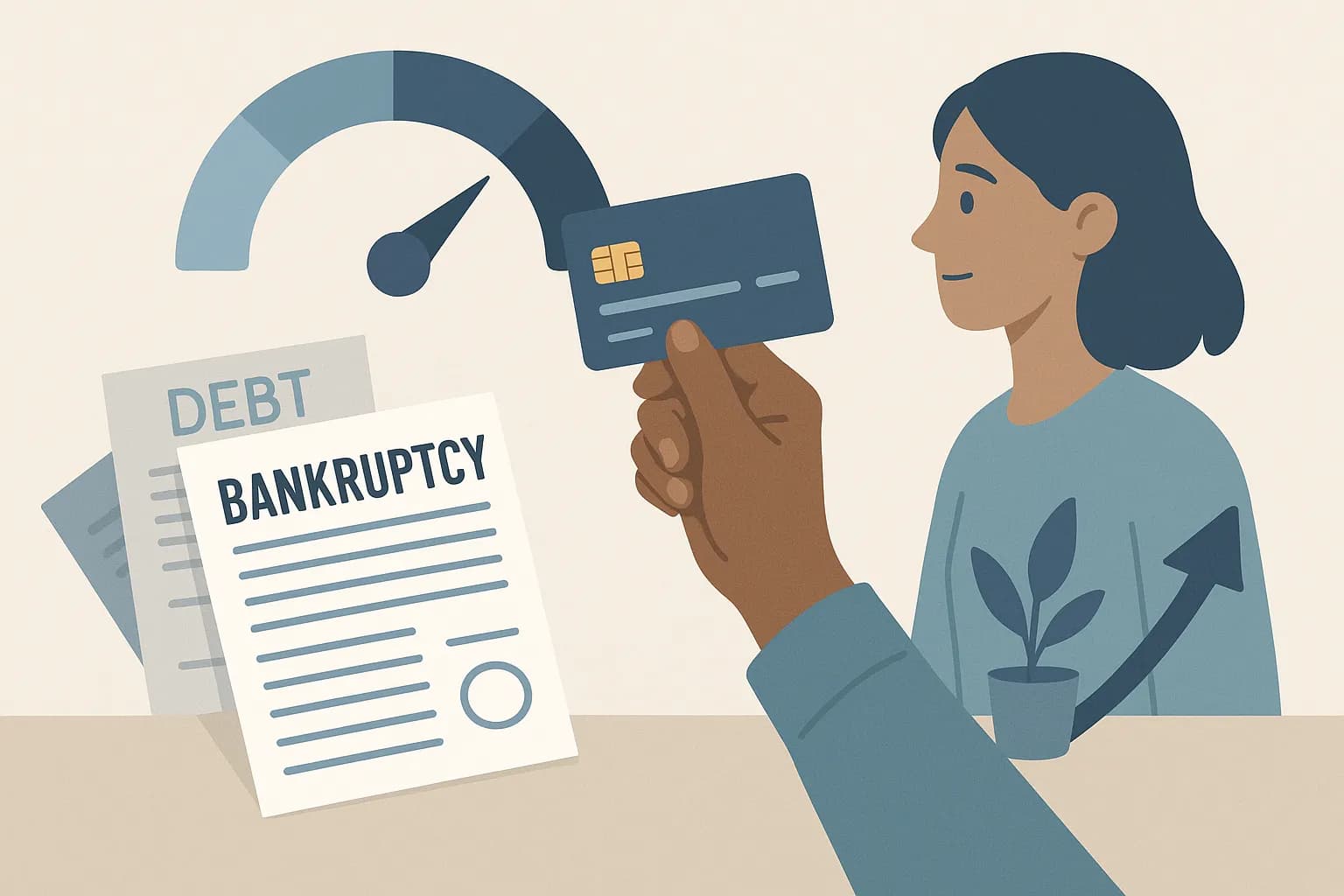
Honest answer: it depends on what's dragging your score down. If your only issue is a thin credit file with no derogatory marks, six months of responsible secured card use can move your score meaningfully. If you're working through the aftermath of bankruptcy or multiple collection accounts, a realistic timeline for reaching the mid-600s is 12 to 24 months of consistent positive behavior. The negative items on your report fade in impact over time even before they fall off entirely. Chapter 7 bankruptcy stays on your report for 10 years, but its weight on your score decreases as it ages and as you layer in positive history alongside it.
Collection accounts stay on your report for seven years from the date of first delinquency. Late payments follow the same seven-year rule. None of this disappears quickly, and that's worth accepting upfront. But here's the thing: lenders and scoring models care more about recent behavior than old mistakes. A 24-month track record of on-time payments, low utilization, and no new derogatory marks can put you in position for mainstream lending products even before the negative marks drop off.
When and how to graduate to an unsecured card
Most people are ready to upgrade after 12 to 18 months. Some issuers do it automatically. Others make you apply for a new card. Be strategic about when you close the secured account so you don't accidentally hurt your score.
At some point, you'll want to graduate from a secured card to an unsecured one. Some issuers handle this automatically after a period of good behavior, typically 12 to 18 months. They review your account, return your deposit, and convert you to an unsecured card with a higher limit. Others require you to apply for a new card and close the secured one. If you have to close the account, think carefully about timing. Closing a card reduces your total available credit and can shorten your average account age, both of which affect your score. I'd suggest keeping the account open as long as possible before closing it, and making sure you have at least one other established positive account before you make the move.
The ideal scenario is an issuer that upgrades you in place, keeping the same account history intact, returning your deposit, and raising your limit. That's worth paying attention to when you're choosing a card to begin with. Ask the issuer directly: what's the upgrade path, and what criteria do you use? A clear answer is a good sign. A vague one might mean there isn't one.
Where to get free help and check your reports for errors
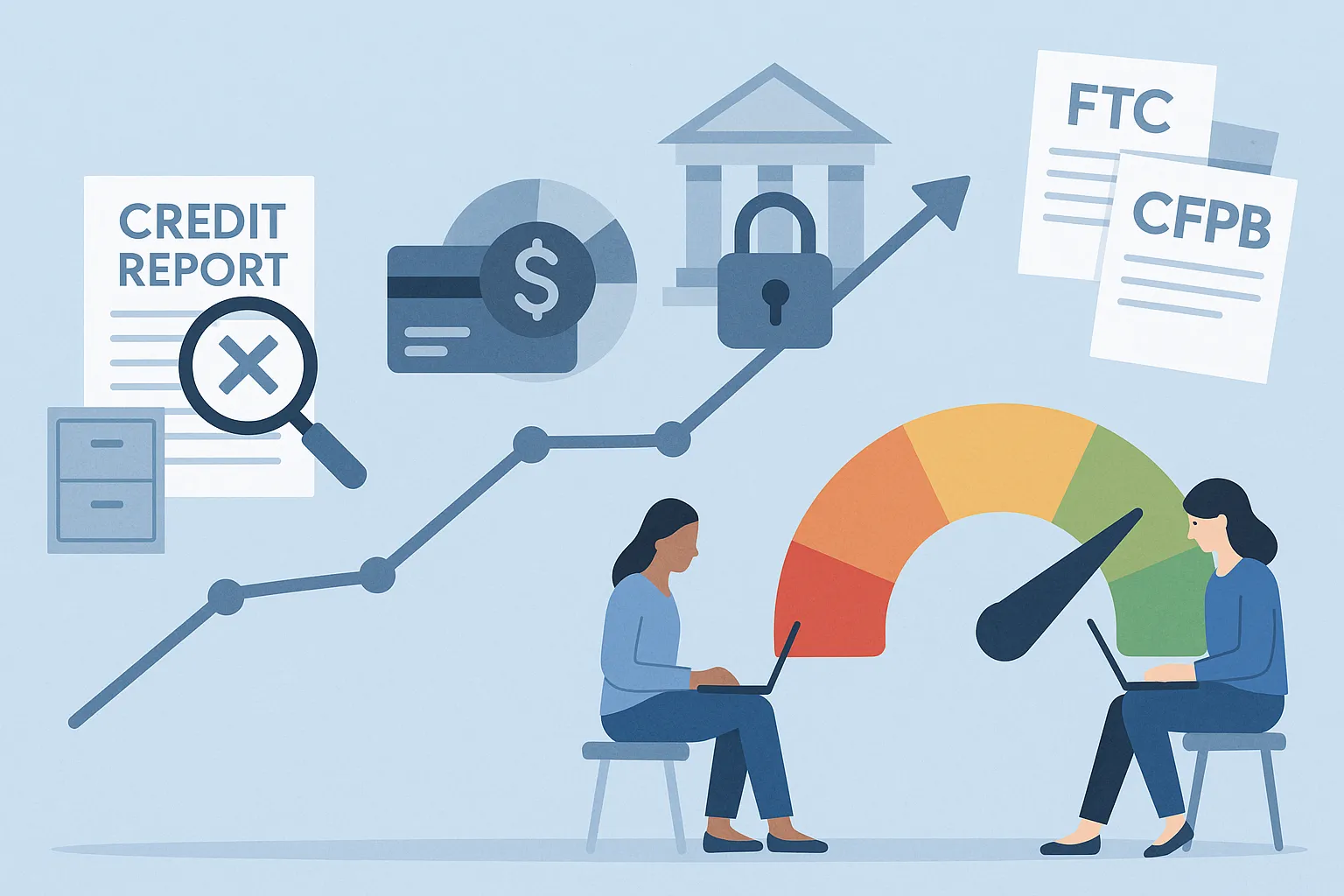
AnnualCreditReport.com is the only federally authorized free report source. Use it. The CFPB and FTC have free dispute guidance. Errors on credit reports are common enough that checking all three bureaus is worth the 30 minutes it takes.
The CFPB and FTC both offer free resources on credit rebuilding, and I'd encourage you to use them. The CFPB's website explains your rights under the Fair Credit Reporting Act, including your right to dispute errors on your credit report. Errors are more common than most people realize. A misreported collection account or an account that belongs to someone with a similar name can pull your score down through no fault of your own. You can pull your credit reports for free every week at AnnualCreditReport.com, which is the only federally authorized source for free reports. Check all three bureaus and dispute anything that looks wrong.
Your next steps, put plainly
Pull your reports, find a card with low fees and three-bureau reporting, make one small charge per month, pay it off in full, and wait. Patience and consistency are the actual product here. Nothing flashy about it.
Here's the short version of where to go from here. Pull your three credit reports this week and look for errors. Choose a secured card with no monthly fees, a low annual fee (under $40 if possible), and confirmed reporting to all three bureaus. Put down the minimum deposit required, usually $200 to $300. Charge one small recurring expense to the card. Pay the balance in full every month. Set a calendar reminder to check your credit score every 90 days. In 12 to 18 months, ask the issuer about upgrading to an unsecured card.
That's it. The process isn't complicated. It just requires patience and consistency, which, after a financial setback, can feel harder than any financial product. But the credit system is, in this one respect, actually fair: it rewards sustained positive behavior. Give it time to see yours.