Why your credit report is the place to start
Before you try anything else, pull your credit reports and look for errors. Errors are more common than most people think, and removing even one inaccurate negative item can move your score faster than months of other effort.
Here's the uncomfortable truth: most people with low credit scores don't have a spending problem. They have an information problem. Errors on credit reports are more common than most people realize. The CFPB has noted that millions of consumers have errors on their credit reports that could affect their scores. Before you do anything else, fix what's already wrong. That single step can move your score more than almost anything else.
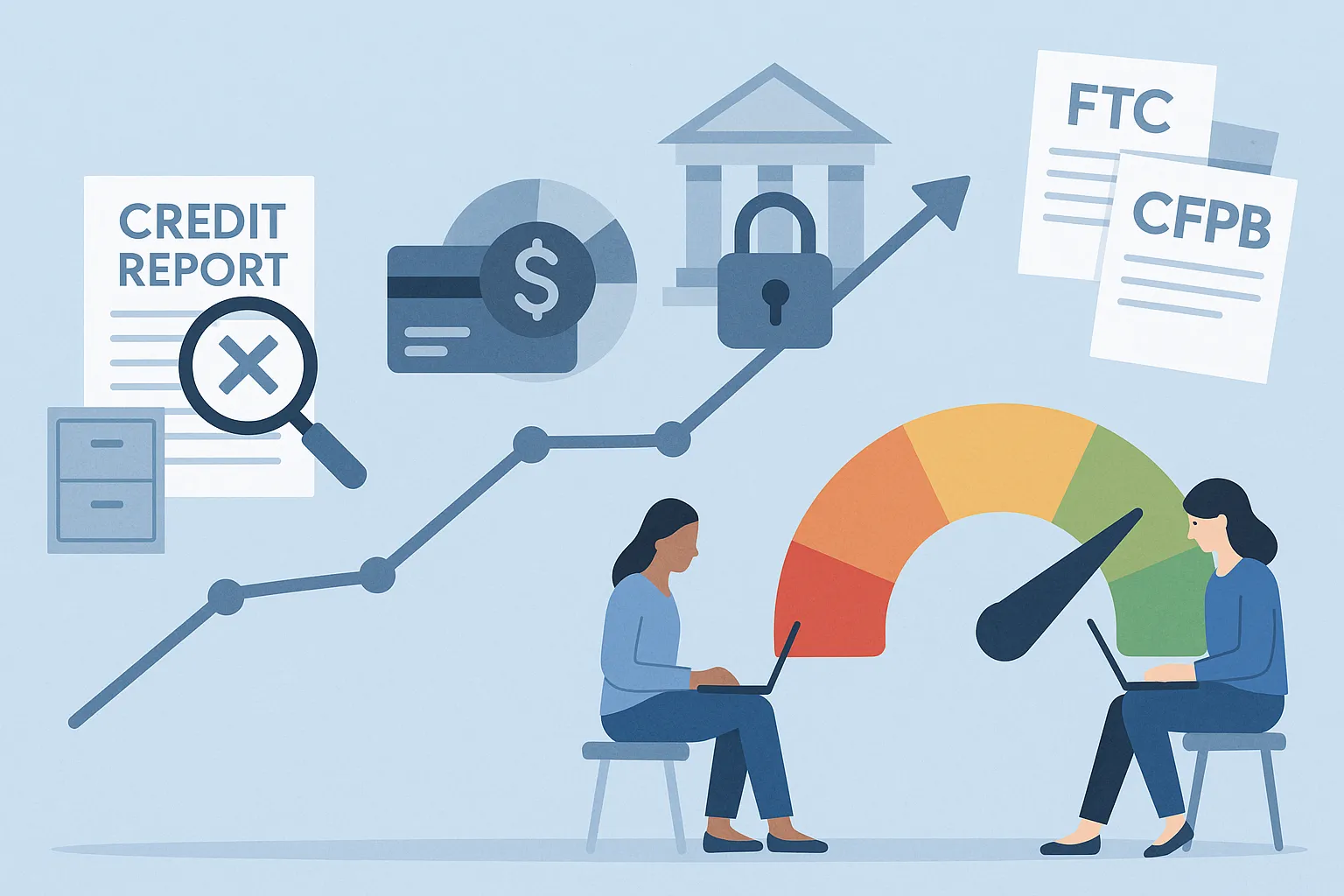
Your credit report is the raw data that feeds your score. You're entitled to free weekly reports from all three bureaus at AnnualCreditReport.com under federal law. Pull all three. Don't just look at one. Errors on one bureau's file don't automatically appear on another's, and lenders often check all three. When you review your reports, look specifically for accounts that aren't yours, late payments marked incorrectly, balances that are outdated, and duplicate collection entries. Any one of these can drag your score down unfairly.
How to dispute credit report errors the right way
Dispute errors in writing, keep documentation, and send everything by certified mail. The bureau has 30 days to investigate, and a confirmed error removal can lift your score within one to two billing cycles.
Disputing errors is a formal process, not a phone call. Under the Fair Credit Reporting Act, you can dispute inaccurate information directly with the bureau (online, by mail, or by phone), and the bureau must investigate within 30 days. Mail disputes are worth the extra effort because you can document everything and send supporting materials. The FTC recommends sending dispute letters by certified mail with return receipt requested. Keep copies of everything. If the bureau confirms an error and removes it, your score can improve within one to two billing cycles.
Credit utilization: the fastest lever you can pull
Utilization is how much of your available credit limit you're using, and keeping it below 30% (ideally below 10%) can add meaningful points quickly. Paying down balances and requesting limit increases are the two fastest ways to move this number.
Credit utilization is the second most powerful factor in your score, after payment history. It measures how much of your available revolving credit you're using. Scoring models generally reward keeping utilization below 30%, and the highest scorers tend to stay below 10%. Here's a concrete example: if you have a $5,000 credit limit and carry a $2,500 balance, your utilization is 50%. Paying that down to $500 drops it to 10%. That shift alone can move your score by 20 to 50 points, depending on your overall credit profile.
One underused tactic: ask your card issuer for a credit limit increase. If you have a $3,000 limit and $1,200 balance, your utilization is 40%. If the issuer raises your limit to $6,000 without you spending another dollar, your utilization drops to 20%. Call the number on the back of your card and ask. Many issuers will do a soft pull rather than a hard inquiry for existing customers, so it won't ding your score. I'd pair this with a targeted paydown, not use it as an excuse to spend more.
Secured credit cards rebuild a damaged credit history
A secured card requires a cash deposit that becomes your credit limit, but it reports to the bureaus just like a regular card. Use it for small recurring purchases, pay it in full monthly, and you'll see positive payment history build within six to twelve months.
If your credit is thin or damaged, a secured credit card is one of the most reliable rebuilding tools available. You deposit money upfront (often $200 to $500), and that deposit becomes your credit limit. Use it for small, recurring purchases, like a streaming subscription or a tank of gas, and pay the full balance every month. The card issuer reports your on-time payments to the bureaus, and over 6 to 12 months, you build a positive payment history. Look for a card with no annual fee and one that reports to all three bureaus. Some secured cards will graduate you to an unsecured card after 12 to 18 months of responsible use.
Credit-builder loans: a lesser-known tool that works
Credit-builder loans let you build payment history without needing existing credit. You make payments on a loan held in escrow, receive the funds at the end, and get the credit history along the way. Credit unions are the best place to find them.
Credit-builder loans work differently but accomplish a similar goal. A credit union or community bank holds a small loan amount (typically $300 to $1,000) in a savings account while you make monthly payments. Once you've made all the payments, you receive the funds. It sounds backward, but the point is the payment history, not the money. Many credit unions offer these for under $20 per month in payments. If you're building from a thin file, a credit-builder loan combined with a secured card is a powerful one-two punch.
Payment history is the single biggest factor in your score
One missed payment can drop your score by 50 to 100 points and stays on your report for seven years. Autopay is the simplest fix. Set it for the minimum, then pay extra manually when you can.
Payment history is the single biggest factor in your score, roughly 35% of a FICO score. One missed payment can drop your score by 50 to 100 points, and that damage lingers for seven years. The fix is simple but requires discipline: set up autopay for at least the minimum payment on every account. I'd set autopay for the minimum, then make manual extra payments when I can. That way, you never accidentally miss a due date because life got busy. If you've already missed payments, time and consistent on-time payments are the only real cure.
Monitor your credit to protect and sustain your gains
Free monitoring tools alert you to new accounts, balance changes, and derogatory marks. A credit freeze at all three bureaus is the strongest identity protection available, and it's free under federal law.
Monitoring your credit isn't just about watching your score go up. It's about catching fraud and errors before they cause serious damage. Several services offer free credit monitoring, including Credit Karma, Experian's free tier, and even some bank accounts. These tools alert you when a new account is opened in your name, when your balance changes materially, or when a derogatory mark appears. Frozen credit at all three bureaus is the strongest protection against new-account fraud. You can freeze and unfreeze for free under federal law. Do it. The few minutes it takes to unfreeze when you need a new account are worth it.
Realistic timelines: how fast can you actually move your score?
Error removals can take 30 to 60 days. Utilization changes show up within one to two billing cycles. Building positive history takes 6 to 12 months. Stack all the steps at once for the fastest results.
Raising your credit score fast is possible, but 'fast' is relative. Disputing a legitimate error and getting it removed can take 30 to 60 days. Paying down utilization reflects in your score within one to two billing cycles after the issuer reports your new balance. Building a positive payment history takes longer: 6 to 12 months of consistent on-time payments before you see meaningful movement. The readers who see the fastest gains usually combine all of these steps at once. Fix errors, lower utilization, add a secured account, automate payments, and monitor everything. That combination can realistically move a 580 score to 640 or higher within six months.