Why this choice matters more than most people realize
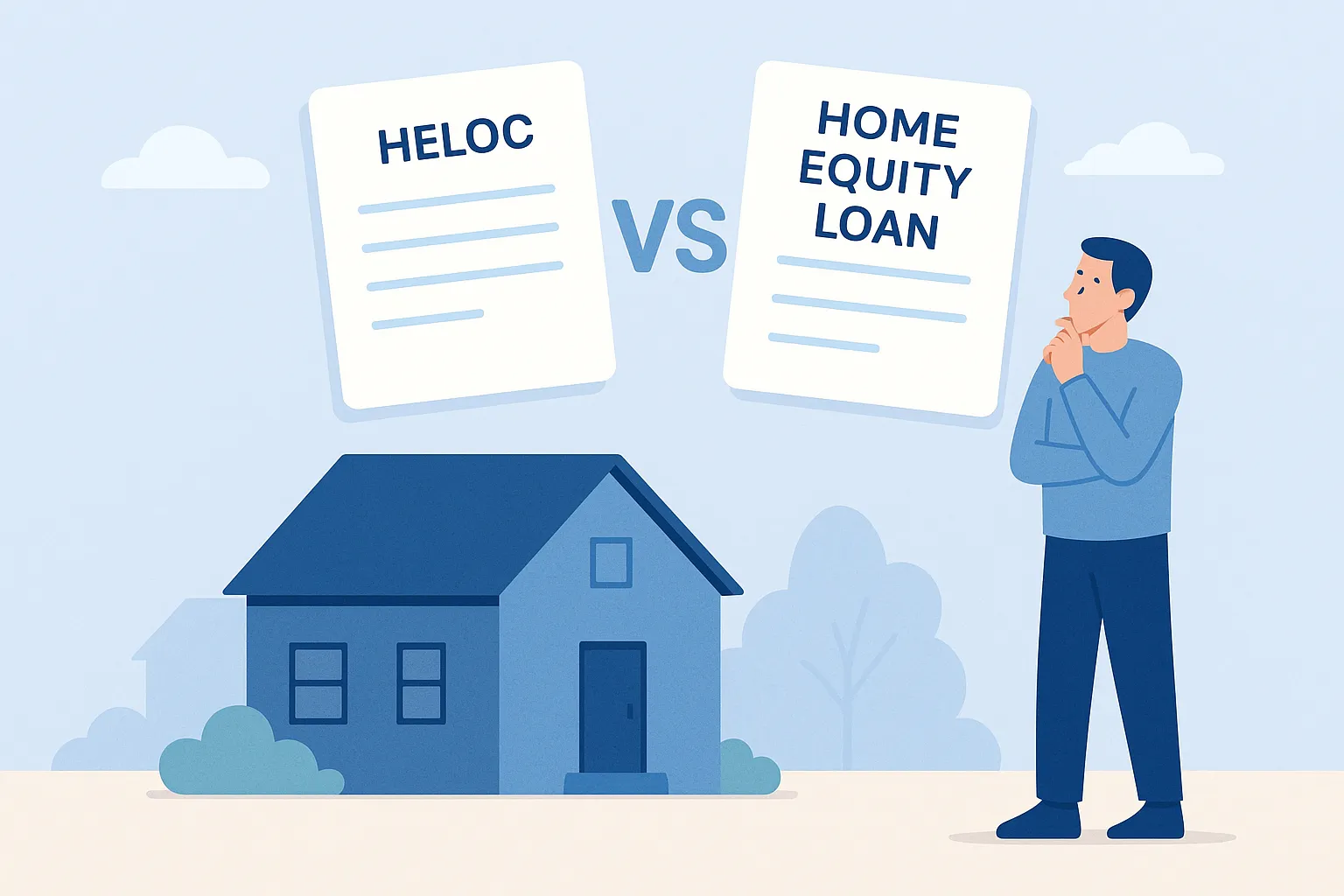
Choosing between a HELOC and a home equity loan isn't just about rates. The structure of each product affects your risk, your monthly payment, and your flexibility for years. Getting it wrong is an expensive mistake.
You've built up equity in your home. Maybe it took five years, maybe fifteen, but it's there, sitting in the walls and the roof, waiting to be used. Now you're staring at a renovation estimate, a tuition bill, or a pile of high-interest credit card debt, and someone told you to 'tap your equity.' Great advice in theory. The problem is that there are two very different ways to do it, and picking the wrong one can cost you real money or leave you scrambling when the terms shift on you. Let's sort it out.
The fundamental structural difference is this: one gives you certainty, the other gives you flexibility. Neither is objectively better. But for most borrowers, one will fit their situation far better than the other, and I'll be direct about which one I'd lean toward in each scenario. First, though, let's understand the mechanics well enough to make a real decision.
How does a home equity loan actually work?
A home equity loan is a lump-sum, fixed-rate loan secured by your house. You get all the money upfront, make equal monthly payments, and the rate never changes. It's essentially a second mortgage.
A home equity loan gives you a single lump sum at a fixed interest rate, repaid in equal monthly installments over a set term, usually 5 to 30 years. Think of it like a second mortgage. You borrow $40,000 on day one, you know your rate, you know your payment, done. The simplicity is the point. There's no guessing what your payment will be in year three, no surprises when the Fed moves rates, no draw period to track.
On a $50,000 home equity loan at 7.5% over 15 years, your monthly payment is roughly $463 and it never changes. That predictability has real value, especially if you're on a fixed income or a tight budget. I'd go fixed for large, one-time expenses where you need to plan around a specific payment. A bathroom gut-renovation with a firm contractor bid is a perfect candidate.
How does a HELOC work, and what's the catch?
A HELOC is a revolving credit line secured by your home. You draw from it as needed during a 10-year draw period, then repay over another 10 to 20 years. The catch is that rates are variable and payments can jump sharply at the end of the draw period.
A HELOC is a revolving line of credit, much more like a credit card secured by your house. You get a credit limit, say $60,000, and you draw from it as needed during a 'draw period' that typically lasts 10 years, paying interest only on what you actually use. That part feels comfortable. The problem is what comes next.
Here's the thing about HELOCs that catches people off guard. During the draw period, your minimum payment is often interest-only. On a $30,000 balance at 8% APR, that's about $200 a month, which feels manageable. Then the draw period ends and you enter repayment, sometimes with no warning, and suddenly you owe principal plus interest on the full outstanding balance. Payments can jump substantially. That transition, called the 'reset,' has genuinely surprised borrowers who weren't tracking it. If you're considering a HELOC, mark that end-of-draw date on your calendar now.
HELOC rates are almost always variable, tied to the prime rate (which tracks the federal funds rate). When the Fed raises rates, your HELOC rate goes up, potentially within weeks. If you opened a HELOC when rates were low and the rate climbs 3 percentage points over two years, a $50,000 balance that cost you $333 per month in interest suddenly costs $458. That's real budget pressure, and it compounds if you also enter repayment during a high-rate environment.
What do lenders actually require to qualify?
Most lenders want at least 15 to 20 percent equity remaining after the loan, a credit score of 620 or higher, and a debt-to-income ratio under 43 percent. A formal appraisal is usually required, so budget $300 to $600 upfront.
To qualify for either product, lenders typically want at least 15 to 20 percent equity remaining in your home after the loan, meaning you can't borrow against 100 percent of what you own. They'll also look at your credit score (most lenders want 620 or higher, though better rates come with 700-plus), your debt-to-income ratio (generally below 43 percent), and your income documentation. Both products require a home appraisal in most cases, which costs $300 to $600 out of pocket. Plan for that.
Closing costs vary. Home equity loans tend to carry costs between 2 and 5 percent of the loan amount. HELOCs often have lower upfront costs, sometimes just a small origination fee, but some lenders charge annual fees of $50 to $100 to keep the line open. Read the fee schedule on any HELOC agreement carefully. Some lenders also impose early closure fees if you pay off and close the line within the first two or three years.
The tax deduction question: does the interest actually save you money?
It might, but only if you use the funds to improve the home. Debt consolidation and tuition payments generally don't qualify under current IRS rules. Run this by a tax professional before you assume the deduction applies.
Tax deductibility is one area where both products share a meaningful (and often misunderstood) benefit. Under current IRS rules, interest on home equity loans and HELOCs may be deductible if the funds are used to 'buy, build, or substantially improve' the home securing the loan. Using the money to consolidate credit card debt or pay tuition? The interest likely is not deductible. This distinction matters if you're doing the math on net borrowing cost, and it's worth a conversation with a tax professional before you borrow.
To be blunt, the deduction is valuable for some borrowers and irrelevant for others. If you're in a lower tax bracket, itemizing deductions anyway, and borrowing for a home improvement project, the math can work in your favor. If you're taking the standard deduction (which most Americans do after the 2017 tax law changes), the mortgage interest deduction may not change your tax bill at all. Don't let a theoretical tax benefit drive a borrowing decision before you know whether it actually applies to you.
The risk that doesn't get enough attention
Both products use your home as collateral. Default means foreclosure, full stop. Converting unsecured debt to secured debt is a serious risk that borrowers who later face income disruptions often regret.
One more risk worth naming clearly. Both products use your home as collateral. If you default, you can lose the house. That's not a hypothetical scare tactic; it's a legal reality. The CFPB has documented cases of borrowers who used home equity to pay off unsecured debt, then ran into hardship and faced foreclosure on debts that previously couldn't touch their homes. Before you convert unsecured debt into secured debt, make sure your income is stable and your budget can absorb the payments even if something goes wrong.
Sound familiar? Many borrowers in 2007 and 2008 were in this exact position. They had used HELOCs to pay off credit cards, and when home values fell and incomes dropped, they were stuck with secured debt they couldn't service on houses worth less than they owed. The lesson isn't that home equity borrowing is bad. The lesson is that it carries real consequences and should be sized conservatively.
HELOC or home equity loan: which one should you choose?
For a single large expense with a known cost, I'd take the home equity loan every time. For ongoing or uncertain expenses spread over several years, the HELOC's flexibility genuinely earns its keep. Your situation dictates the answer.
If you're funding a single large project with a known cost, like a kitchen remodel or a debt payoff, I'd lean toward the home equity loan. Fixed rate, fixed payment, done. If you're funding something ongoing or uncertain, like a business startup, a phased renovation, or college tuition spread over four years, the HELOC's flexibility is genuinely valuable. You only pay interest on what you draw, which can mean real savings versus borrowing a lump sum and sitting on cash you haven't needed yet.
Here's a quick mental framework. Ask yourself: do I know exactly how much I need, and do I need it all at once? If yes, go with the home equity loan. Is the amount uncertain, will I draw it over time, and can I handle a variable rate? Then a HELOC may be the smarter tool. And if you're worried about the HELOC's variable rate but love the flexibility, some lenders offer the option to lock a portion of your HELOC balance at a fixed rate mid-draw. Ask about that feature when you shop.
Your next steps: how to actually move forward
Start with your equity, get at least three quotes, and compare APRs not just rates. Don't skip the math on closing costs. This is a serious financial decision, so spend the time to do it right.
Here's how I'd approach next steps. Start by getting a current estimate of your home's value (online tools like Zillow or Redfin give rough figures; a formal appraisal gives you the real number). Subtract what you owe on your mortgage. That difference is your equity. Most lenders will let you borrow up to 80 to 85 percent of your home's appraised value across all loans combined. Run that math before you walk into any lender conversation so you know your ceiling.
Then get quotes from at least three lenders, including your current mortgage servicer, a local credit union, and an online lender. Compare APRs, not just rates, because closing costs on these products can range from $200 to $2,000 depending on the lender and your state. The best deal is rarely the one with the flashiest rate. Ask each lender for a full fee schedule in writing, and ask specifically whether there are prepayment penalties or annual fees. The CFPB's website has a home equity loan and HELOC guide that can help you prepare good questions before those conversations. Use it.
One final thought. Tapping your home equity is not inherently good or bad. It's a tool. Like any financial tool, it works well when it's matched to the right job and sized appropriately. The borrowers who get into trouble are the ones who treat it as free money or who borrow more than they need because the limit is there. Borrow what you need, understand the terms completely, and keep your payments well within your budget even in a worst-case income scenario. That's the discipline that keeps this kind of debt from becoming a crisis.