Why do these age-based benchmarks even matter?
They matter because they give you a gut-check, not a grade. I use them the same way I use a bathroom scale: useful data, not a moral judgment.
I remember sitting across from a friend in Austin, Texas a few years back who was 42, made $95,000 a year, and had about $38,000 saved for retirement. She was convinced she'd failed. Honestly? She was behind, but not doomed. The most common benchmark, from Fidelity Investments, suggests having 1x your salary saved by 30, 3x by 40, 6x by 50, 8x by 60, and 10x by 67. These numbers get quoted constantly, so let's be clear about what they actually are: rough targets built on assumptions about a steady career, consistent saving, and market returns that may or may not match your life.
Here's the thing nobody tells you: these multiples assume you'll retire around 67, replace about 80% of your pre-retirement income, and that Social Security fills in a chunk of the rest. If you plan to retire at 58, or you're supporting aging parents, or you had a decade of gig work with no employer match, the math shifts. I've seen people torch themselves with anxiety over a benchmark that was never built for their situation. Use it as a compass, not a report card.
In your 20s: the decade that quietly does the heaviest lifting
Save something, even if it's small, and get the full employer match if one exists. The dollars you put in at 25 are worth roughly triple what the same dollars are worth at 45, thanks to compounding.
I know a guy in Columbus, Ohio who started putting $75 a month into his 401(k) at 23 because that's all he could spare after rent and student loans. By 30 he'd bumped it to $300 a month. He's 34 now with about $61,000 saved, and he didn't do anything fancy. No stock picking, no crypto detour. Just automatic contributions and time. That's the whole trick in your 20s: time is doing 70% of the work, you're only doing 30%.
The benchmark for age 30 is roughly 1x your salary. If you're making $50,000 and you've got $35,000 saved, you're close enough not to panic. If you've got $5,000, don't spiral, just start increasing your contribution rate by 1% every six months. Small moves compound. And please, if your employer offers a match (a common one is 50% up to 6% of pay), contribute at least enough to get it. Walking away from a match is walking away from free money, full stop.
In your 30s: debt, kids, and daycare are eating your progress
The 3x salary by 40 target is aggressive for a lot of people, and I think that's fine to say out loud. If you're at 1.5x or 2x, you're not behind, you're normal.
This is the decade where I've seen the most guilt. A reader in Charlotte, North Carolina emailed me last year: two kids in daycare at $1,400 a month combined, a mortgage, and a 401(k) balance of $42,000 at age 37 on a household income of $110,000. By Fidelity's math she should have had $330,000. She felt like a failure. She wasn't. Childcare costs alone can eat 15 to 20% of take-home pay in your 30s, and that's money that simply can't go toward retirement in the same years.
My advice for this decade is boring but it works: automate a contribution increase of 1% every year, ideally tied to your raise so you never feel it hit your paycheck. If your employer plan lets you set an auto-escalation feature, turn it on today. Also, resist the urge to raid your 401(k) for a home down payment. I've watched people do this and regret it within five years once they see the account balance they gave up, plus the 10% early withdrawal penalty if they're under 59 and a half and it's not a qualifying exception.
In your 40s and 50s: this is when catch-up contributions start to matter
At 50, you can contribute an extra $8,000 to a 401(k) beyond the regular limit, and that catch-up window is bigger than most people realize. Use it if you possibly can.
For 2025, the standard 401(k) contribution limit is $23,500. If you're 50 or older, you can add a $7,500 catch-up contribution, bringing your total to $31,000. And thanks to SECURE 2.0, workers aged 60 to 63 get an even bigger catch-up limit this year, up to $11,250 instead of $7,500, for a total of $34,750. That's not a typo. Congress built in a bigger ramp specifically for people staring down retirement with a gap to close. If you're 61 and behind, this is your moment to lean in hard.
I talked to a woman in Denver, Colorado who was 54, had $210,000 saved, and felt like she was starting from scratch. The 50 benchmark says 6x salary, so on her $88,000 income she'd want around $528,000. She wasn't there. But she maxed out her catch-up contributions for four straight years, got a modest employer match, and by 58 she'd pushed her balance to just over $410,000. Not the benchmark number, but a completely different trajectory than where she started. The 40s and 50s reward aggressive, uncomfortable saving more than almost any other decade, because your income is usually at its peak.
In your 60s: this is where the plan meets reality
By 60, the target is roughly 8x salary, and by 67 it's about 10x. But honestly, what matters more at this point is your withdrawal strategy and your Social Security timing, not just the balance itself.
Full retirement age for Social Security is 67 if you were born in 1960 or later. Claim at 62 and you lock in a permanent reduction of about 30% compared to waiting until 67. Wait until 70 and you get an 8% annual increase for each year past full retirement age. I'll be blunt: if you can afford to wait, waiting is usually the better move, especially if you expect to live into your mid-80s or beyond, which is increasingly the norm according to Social Security Administration data.
I've seen retirees in Sarasota, Florida claim at 62 out of fear the program would disappear, then regret it a decade later when their monthly check was a third smaller than a spouse's who waited. Nobody can predict the future of Social Security funding with certainty, but the trust fund reserves are currently projected to last into the mid-2030s before requiring adjustments, not disappear entirely. That's a very different story than what gets repeated at dinner parties. Talk to a fee-only financial planner before you claim. This is a decision that's hard to unwind once made.
What if I'm nowhere close to the benchmark?
You're not alone, and panic doesn't fix anything. Focus on the levers you actually control: contribution rate, retirement age, and spending, in that order.
According to the Federal Reserve's 2023 Survey of Consumer Finances, the median retirement account balance for households aged 55 to 64 was just $185,000. That's well below the benchmark multiples for that age group for most income levels. So if you're staring at a number that feels embarrassingly small, look around: you've got company, a lot of it. I say this not to normalize under-saving, but to take some of the shame out of the conversation so people can actually act instead of freezing.
The three real levers are contribution rate, working a few extra years, and adjusting your expected retirement lifestyle. Working from 62 to 66 instead of retiring at 62 can add hundreds of thousands of dollars in lifetime value once you factor in delayed Social Security, more years of contributions, and fewer years of withdrawals. It's not glamorous advice. Nobody wants to hear 'work longer.' But it's often the single most powerful adjustment available to someone in their late 50s who's behind.
So, what should you actually do this month?
Pick one concrete action today: check your contribution rate, confirm you're getting your full match, or open a Roth IRA if you don't have one. Don't try to fix your whole retirement plan in a weekend.
Start small. Seriously. The biggest mistake I see is people trying to overhaul their entire financial life in one sitting, get overwhelmed, and do nothing for another two years. Instead, log into your 401(k) provider (Fidelity, Vanguard, Empower, whatever you've got) this week and check two numbers: your current contribution percentage and whether you're getting the full employer match. If you're not, fix that first. It's the highest-return move available to almost anyone with a workplace plan.
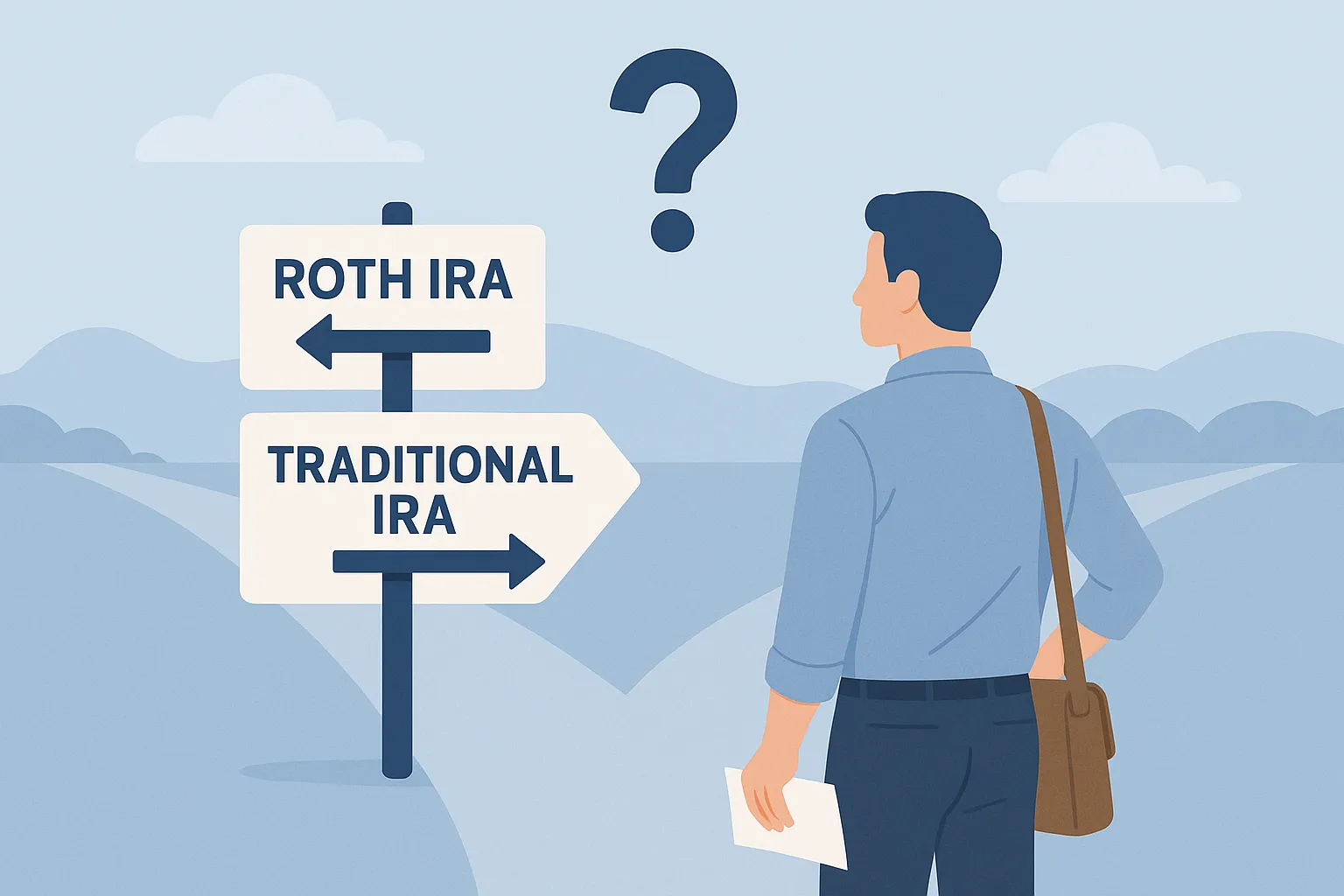
After that, consider a Roth IRA if your income qualifies (in 2025, the ability to contribute phases out between $150,000 and $165,000 for single filers, and $236,000 to $246,000 for married couples filing jointly). The contribution limit is $7,000, or $8,000 if you're 50 or older. A Roth gives you tax-free withdrawals in retirement, which matters a lot if you think tax rates will be higher decades from now. I can't tell you exactly what to do with your specific numbers, that's a conversation for a fee-only CFP, but I can tell you that doing something this month beats doing nothing for another year.