Why this choice matters more than most people realize
Picking the wrong tool here can mean paying thousands more in interest or watching a plan collapse halfway through. I've seen both scenarios play out. The good news is that understanding a few key variables makes the choice pretty clear.
I've sat across the table (figuratively, over email) from hundreds of people drowning in credit card debt, and the question I get more than almost any other is this: should I consolidate my debt or do a balance transfer? It sounds like a simple either/or, but the answer depends on a handful of factors most people never think to check. Let me walk you through both options with the kind of honesty I wish someone had given me earlier.
What is a debt consolidation loan and how does it work?
You take out one new loan, pay off all your existing debts, and then repay that single loan at a fixed rate over a set term. It trades chaos for structure, which is genuinely valuable when you have multiple balances piling up.
A debt consolidation loan is exactly what it sounds like. You borrow a lump sum, typically from a bank, credit union, or online lender, and use it to pay off multiple debts at once. Then you repay that one loan over a fixed term, usually 24 to 84 months, at a fixed interest rate. In early 2025, personal loan rates from reputable lenders like LightStream, SoFi, and Marcus by Goldman Sachs range from about 7.99% APR to 35.99% APR depending on your credit score. If you're carrying $18,000 across four credit cards averaging 24% APR, locking in a consolidation loan at 12% APR saves you real money.
What is a balance transfer card and when does it shine?
You move your existing credit card debt onto a new card with a 0% promotional APR for 15 to 21 months. If you pay it off during that window, you pay almost no interest. The catch is that you have to actually pay it off.
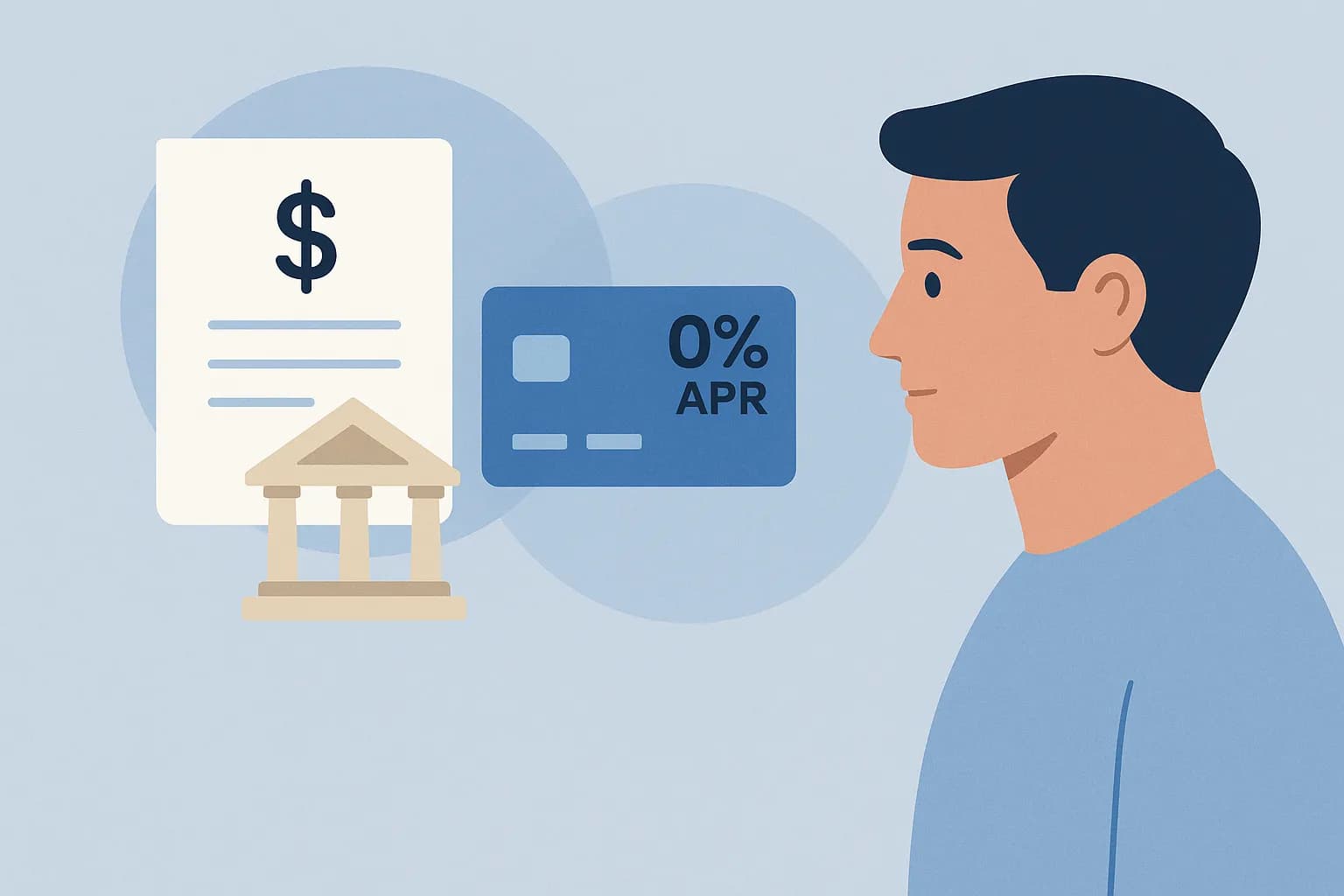
A balance transfer card lets you move existing credit card debt onto a new card that offers a 0% promotional APR for a limited period. As of 2025, the best offers come from issuers like Citi, Wells Fargo, and Chase, and they typically run 15 to 21 months interest-free. There's usually a balance transfer fee of 3% to 5% of the amount transferred. So on $10,000 transferred, you'd pay $300 to $500 upfront. But if you pay off that balance during the promo window, you're done with no interest. That's a powerful tool if, and this is a big if, you have the discipline to actually do it.
Here's the thing most articles skip: these two options aren't really competitors. They serve different people in different situations. Balance transfers are for people with good-to-excellent credit (typically 670 or above) who have a manageable amount of debt they can realistically pay off within 15 to 21 months. Debt consolidation loans are for people with larger balances, longer timelines, or slightly lower credit scores who need a structured, predictable repayment plan. Knowing which camp you're in is the whole game.
Your credit score often makes the decision for you
Balance transfer cards with 0% APR want a score of 670 or higher, often 720-plus for the best offers. Below that threshold, a consolidation loan through a credit union or an online lender is usually the more realistic path.
Credit score is where this decision often gets made for you before you even apply. Balance transfer cards with 0% intro APR offers generally require a credit score of 670 or higher, and the best cards want 720 or above. I've seen people with scores in the 580s apply for a Citi Double Cash or a Wells Fargo Reflect card, get denied, and feel defeated. That's not failure; that's just mismatched tools. If your score is below 670, a debt consolidation loan through a credit union or an online lender like Upstart (which uses education and employment data in its model) might be a more realistic path.
The real cost breakdown: fees, rates, and total interest paid
Balance transfer fees of 3-5% look small but add up on large balances. Personal loan origination fees vary from zero to 6%. The math almost always favors whichever option you can commit to completing.
Let's talk about fees and the real cost of each option. Balance transfer fees of 3% to 5% can add up fast. Transfer $15,000 and you're looking at $450 to $750 added to your balance before you make a single payment. On the other hand, most online personal loans for debt consolidation have no origination fees (LightStream, for example, charges none), though some lenders charge 1% to 6%. The math here matters enormously. Run the numbers with actual APRs, not promotional ones, because that 0% offer becomes a 25.99% rate the morning after your promo period ends if you haven't cleared the balance.
The psychology factor: which plan do you actually finish?
Balance transfers demand strict, fast repayment with no room for slip-ups. Consolidation loans give you a fixed payment and a fixed end date. In my experience, the structure of a loan is worth a lot if you've ever struggled to stay on track.
I'll be blunt about the psychological dimension here, because it matters as much as the math. Balance transfers demand discipline. You get 18 months at 0%, and in my experience, a lot of people treat month 16 like they have all the time in the world. Then the promo expires and they're sitting on $6,000 still owed at a sky-high go-to rate. Debt consolidation loans remove that variable. You have a fixed payment, a fixed rate, and a fixed end date. There's no penalty for not paying it off fast enough (assuming no prepayment penalty). That structure is worth something, especially if you've struggled with variable-rate debt before.
So which one actually wins for most people?
For balances over $10,000, I favor consolidation loans because the monthly payment is realistic enough to actually complete. For smaller balances under $6,000 with strong credit, a balance transfer is hard to beat if you treat it with discipline.
So which one wins? Honestly, for most people carrying more than $10,000 in credit card debt, I'd lean toward a debt consolidation loan. Here's why. A 15-to-21 month payoff window on a balance transfer sounds doable, but on $12,000 that means paying $571 to $800 per month, every month, with no slip-ups. That's a brutal pace for most budgets. A 48-month consolidation loan at 13% APR on that same $12,000 runs about $322 per month. Way more manageable. Yes, you pay more total interest over four years versus zero interest in 18 months, but the completed loan beats the failed balance transfer every single time.
If your debt is under $6,000 and your credit score is solid, though, go the balance transfer route. A friend of mine in Austin transferred $5,400 onto a Wells Fargo Reflect card in early 2024, paid $300 per month for 18 months, and wiped the balance with weeks to spare. She paid a $162 transfer fee and zero interest. That's practically free money if you treat it with the respect it deserves. The key was automating the payments so she never missed one and never accidentally spent into the card's revolving limit.
The traps both options set (and how to avoid them)
Consolidation loans free up credit card space that some people immediately refill with new debt. Balance transfers carry revert rates as high as 28.99% that kick in the second the promo period ends. Both traps are avoidable if you know they're coming.
Watch for the traps both options set. With consolidation loans, the trap is using the freed-up credit card space to rack up new debt. I've seen it happen within three months of someone getting a consolidation loan. They paid off four cards, felt relief, then slowly charged them back up. Now they have a loan AND fresh card debt. Lock those cards in a drawer, cut them up, or call and lower the limits. With balance transfers, the trap is the revert rate. Read the fine print. Some cards revert to 28.99% or higher. One missed payment can also void the promo rate on some cards, which the CFPB has flagged as a consumer concern worth watching.
Your next steps: a clear action plan
Check your credit score first, then match it to the right tool. Get prequalified before you apply to avoid unnecessary hard inquiries. Then pick the option you will actually complete, not the one that looks best on paper.
Here's your action plan. First, pull your credit score for free through your bank app, Credit Karma, or AnnualCreditReport.com. If you're above 700 and your debt is under $8,000, start comparing balance transfer offers at CardRatings.com or NerdWallet. If you're below 680 or carrying more than $10,000, get prequalified (soft pull, won't hurt your score) at two or three online lenders like SoFi, LightStream, or Marcus. Compare the APR, term, monthly payment, and total cost. Then pick the option that you will actually complete, not the one that looks best on paper.