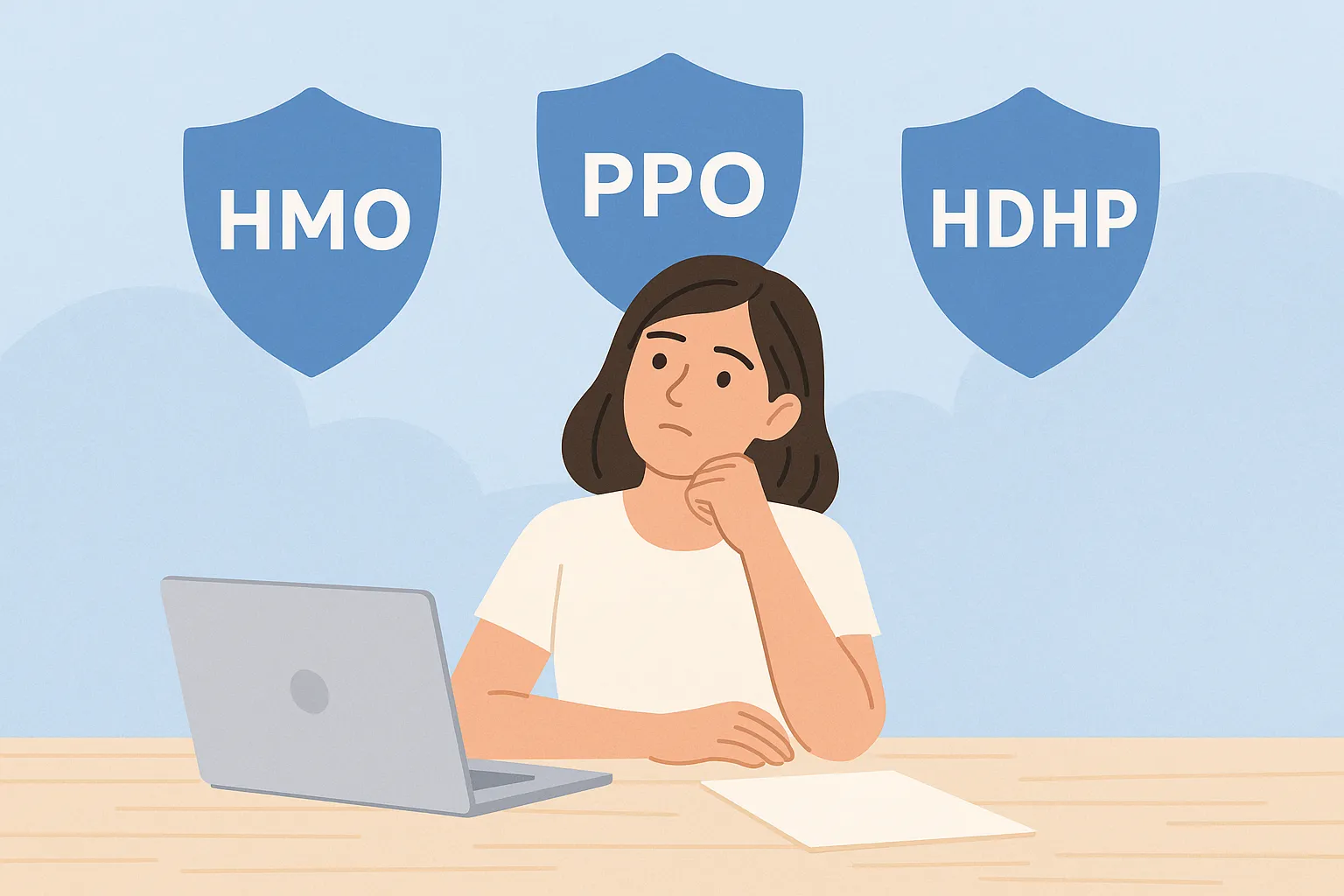
Why picking the wrong plan can cost you thousands
The difference between a good and bad plan choice can easily run $1,000 to $3,000 or more in a single year. It's not about picking the cheapest premium. It's about understanding the full cost picture before you commit.
Open enrollment arrives every fall, and with it comes a stack of plan summaries that read like they were written by robots for other robots. You're staring at acronyms, deductibles, and coinsurance percentages, trying to figure out which plan won't bankrupt you if something goes wrong. Here's the thing: picking the wrong plan can cost you thousands of dollars a year, but picking the right one is very doable once you understand what you're actually comparing. This guide cuts through the jargon and gives you a real framework for deciding.
What is an HMO and who should consider it?
An HMO keeps costs low by requiring you to work through a primary care doctor and stay in-network. It's a solid choice for healthy people who want predictable, affordable coverage without a lot of specialist needs.
An HMO, or Health Maintenance Organization, is built around a primary care physician who acts as your quarterback. You pick one doctor from the plan's network, and that doctor manages your care and sends you to specialists when needed. The trade-off is tight: you almost always need a referral to see a specialist, and going outside the network is usually not covered at all. In exchange, premiums and out-of-pocket costs tend to be lower. For healthy people who don't anticipate needing a lot of specialized care, an HMO can be a genuinely smart, cost-efficient choice.
One thing worth noting: HMOs aren't just for people who never get sick. They can work well for families with kids who have straightforward pediatric needs, or for adults managing a single chronic condition through one specialist they already see regularly. The key question is whether your care can flow through one coordinating physician without creating friction. If the answer is yes, the premium savings are real money back in your pocket every month.
What is a PPO and when does the flexibility justify the cost?
A PPO lets you see any doctor without a referral, which is genuinely useful if you have specialist relationships or complex care needs. But you pay for that freedom through higher premiums, often by hundreds of dollars a month.
A PPO, or Preferred Provider Organization, flips that model. You can see any doctor you want, inside or outside the network, without a referral. That flexibility is real and valuable, especially if you have existing relationships with out-of-network specialists or you live in a rural area where the in-network options are thin. The cost of that freedom is higher premiums, usually by a noticeable margin. On a plan with a $400 monthly premium versus a comparable HMO at $260, you're paying $1,680 more per year just for the privilege of skipping the referral step. Whether that's worth it depends heavily on how often you actually use that flexibility.
For people managing chronic conditions, PPOs often make financial sense even with the premium gap. If you see a rheumatologist, an endocrinologist, and a cardiologist on a rotating basis, the coordination costs of an HMO add up in time and frustration, not just dollars. The referral requirement isn't just bureaucratic; it introduces delays. And in healthcare, delays matter. If the flexibility of a PPO means you actually get timely, coordinated care from specialists you trust, that's a real health benefit, not just a convenience.
What is an HDHP and how does the HSA change the math?
An HDHP pairs a low monthly premium with a high deductible, and the HSA that comes with it is legitimately one of the best tax-advantaged accounts available. If you're healthy and financially stable enough to absorb a higher deductible, this combination can be a long-term wealth builder.
A High-Deductible Health Plan, or HDHP, operates on a different logic entirely. The IRS defines an HDHP as any plan with a deductible of at least $1,600 for an individual or $3,200 for a family in 2024. You pay more out of pocket before insurance kicks in, but your monthly premium is much lower. The real advantage is that HDHPs are the only plans that qualify you for a Health Savings Account, or HSA. An HSA lets you contribute pre-tax dollars to cover medical expenses, and in 2024 those contribution limits are $4,150 for individuals and $8,300 for families. The money rolls over year to year and can even be invested, which makes it a legitimate long-term savings tool.
Here's what makes the HSA genuinely compelling: contributions are pre-tax, growth is tax-free, and withdrawals for qualified medical expenses are also tax-free. That's a triple tax advantage you won't find in a 401(k) or IRA. Some people with HDHPs pay current medical expenses out of pocket, let the HSA investments grow, and reimburse themselves years later from accumulated growth. That strategy requires discipline and a financial cushion, but it's not a fringe tactic. It's a real optimization. The catch is that if you drain your deductible in January because of an unexpected event, the premium savings evaporate fast. Having an emergency fund equal to your deductible is basically a prerequisite for this plan type to work.
Real cost comparison: how to run the break-even math
The only way to truly compare plans is to run the numbers for your actual situation. The premium difference and deductible difference tell you almost everything you need to know.
To make the comparison concrete, think through a simple illustrative scenario. Imagine you're choosing between a PPO at $380 per month with a $500 deductible and an HDHP at $210 per month with a $1,800 deductible. The PPO costs $2,040 more per year in premiums alone. If you stay healthy and use minimal care, the HDHP wins by a wide margin, and you get to stash the savings difference into an HSA. But if you hit the $1,800 deductible in January because of an unexpected surgery, the math shifts. This is why honest self-assessment about your health situation matters more than any rule of thumb.
The break-even calculation is straightforward. Subtract the HDHP premium from the PPO premium and multiply by 12. That's your annual premium savings with the HDHP. Then compare that to the deductible gap between the two plans. If your premium savings exceed the deductible gap, the HDHP is the better bet financially unless you know you'll hit the deductible. If the deductible gap is larger than the premium savings, a lower-deductible plan may protect you better. Run this math every single enrollment period because the numbers change year to year.
The network trap: why you must check before you enroll
Network coverage is where people get blindsided. Before you pick any plan, verify that your actual doctors are in-network. Don't assume. Call and confirm.
The network question is one people underestimate until it bites them. Before you enroll in any plan, look up whether your current doctors are in-network. Not every physician in a hospital you trust is automatically covered by your plan, and surprise bills from out-of-network providers at in-network facilities are a real and costly problem. The No Surprises Act, which took effect in 2022, offers some protection for emergency care and certain other situations, but it doesn't cover every scenario. Call your doctor's billing office directly and ask. Don't assume. A five-minute phone call can save you hundreds or even thousands of dollars.
Provider directories on insurance company websites are notoriously outdated. A 2022 report from the HHS Office of Inspector General found widespread inaccuracies in Medicare Advantage provider directories, a problem that also affects commercial plans. The safest approach is to call both your insurer and your doctor's office to verify participation before you commit. If a specialist you rely on is out-of-network under an HMO, the cost difference between that plan and a PPO may shrink considerably once you factor in what you'd pay for out-of-network care.
Which plan type fits your situation?
Honestly, there's no universal winner. But there are clear patterns: HDHPs for healthy savers, HMOs for cost-focused patients with simple needs, and PPOs for people with complex or chronic care situations.
HDHPs pair best with disciplined savers who are generally healthy and want to treat their HSA like a bonus retirement account. I'd lean toward an HDHP if you're young, healthy, have an emergency fund to cover your deductible, and want to build long-term tax-advantaged savings. HMOs make the most sense if you want low monthly costs, you're comfortable with a primary care gatekeeper model, and you rarely need specialist care. PPOs are the right call if you have complex or chronic conditions, you have established specialist relationships you don't want to disrupt, or your family's care needs are unpredictable. No single plan type is universally best.
One more consideration: family situations change the calculus. A family with young children who make frequent pediatric visits may find an HMO's low copays more predictable than an HDHP's deductible exposure. But a two-income household with substantial savings and generally healthy kids might come out well ahead with an HDHP and a maxed-out family HSA. Think about the whole household's health history, not just one person's.
Your open enrollment action plan
Treat open enrollment like a deadline, not a suggestion. Pull your actual healthcare spending from last year, run the break-even math, and make a deliberate choice. Defaulting to last year's plan without reviewing it is how people leave money on the table.
Open enrollment typically runs for a few weeks in the fall for employer-sponsored plans, and from November 1 through January 15 for marketplace plans under the ACA. Missing that window usually means you're locked into your current plan until the next year, unless you have a qualifying life event like marriage, a birth, or job loss. So treat open enrollment as a real deadline, not a suggestion. Pull out your explanation of benefits from this year, add up what you actually spent on healthcare, and compare that to what you would have paid under each available plan. That math is more valuable than any general advice, including this article.
Your final decision should come down to four factors: your expected healthcare usage, your financial cushion to handle a high deductible, whether your current providers are in-network, and the specific premium and deductible numbers your employer or marketplace is offering. Run the break-even math. If the premium difference between two plans is $1,500 per year, ask yourself how likely you are to spend more than $1,500 on care beyond the lower-cost plan's deductible. Be honest. Most people overestimate how much care they'll need in a given year. But if you're managing a chronic condition or expecting a major procedure, don't let a low premium lure you into a plan that leaves you exposed.