Why life insurance feels so overwhelming (and why it doesn't have to)
The topic feels complicated because the insurance industry profits from complexity. Once you strip away the jargon, there are really only two core questions: what type, and how much.
Life insurance is one of those topics that somehow manages to feel both urgent and impossibly complicated at the same time. You know you probably need it. You've maybe gotten a quote, felt vaguely alarmed by the jargon, and then quietly closed the browser tab. Sound familiar? You're not alone. The good news is that the core concepts are genuinely not that hard once someone cuts through the sales pitch and explains them plainly. That's what this guide is here to do.
What is term life insurance?
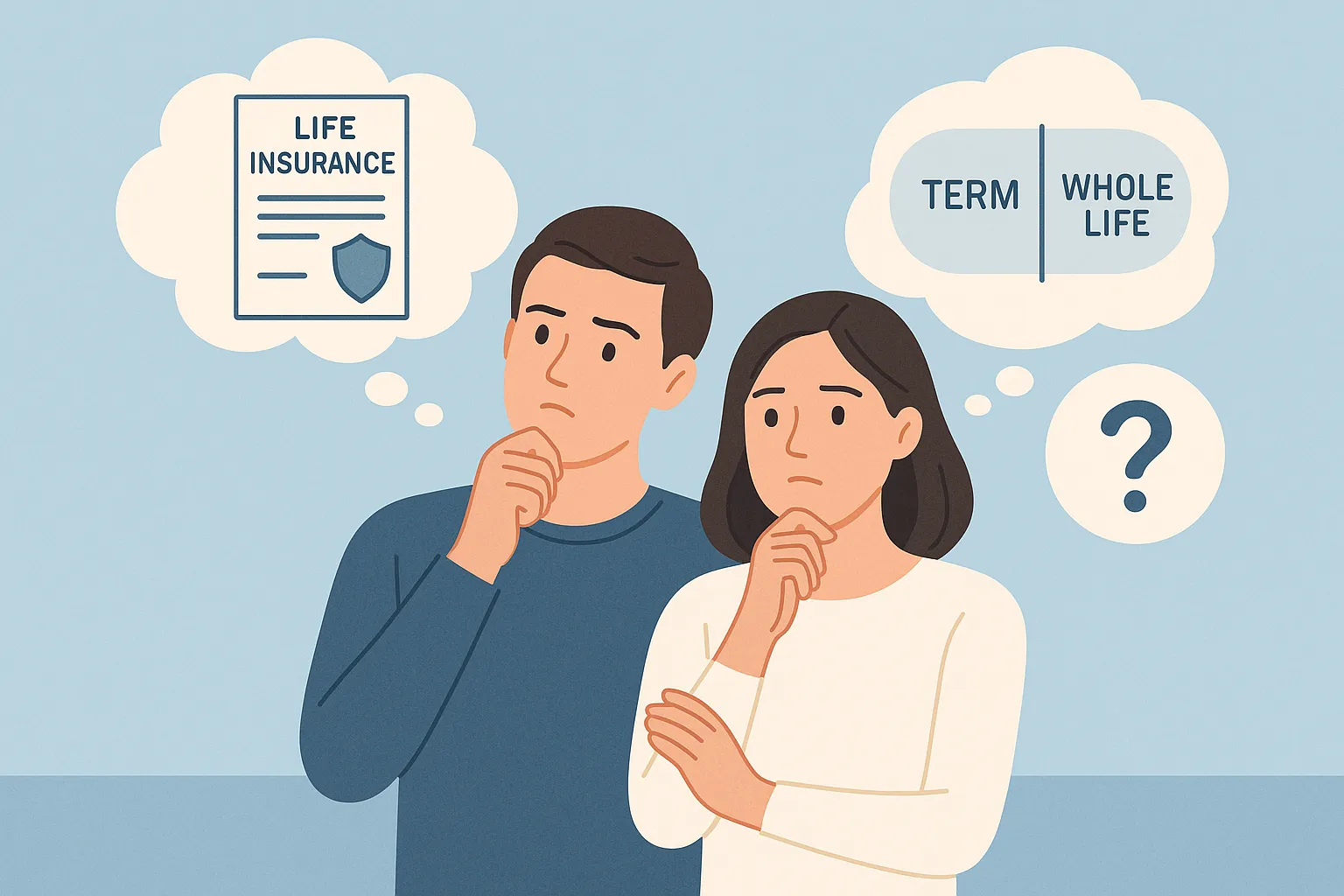
Term life is temporary coverage for a set number of years. You pay premiums, your family gets the death benefit if you die during the term, and the policy expires if you don't. Simple, affordable, and effective for most people.
Term life insurance is the simpler of the two main types. You pay a monthly or annual premium for a set period (the 'term'), typically 10, 20, or 30 years. If you die within that term, your beneficiaries receive the death benefit. If you outlive the policy, it expires and you get nothing back. That last part sounds harsh, but here's the thing: it's not necessarily a bad deal. Think of it like car insurance. You don't feel cheated when you don't crash.
A 35-year-old in good health can often get a 20-year, $500,000 term life policy for somewhere in the range of $25 to $35 per month. That's a real, affordable number for most households. The exact premium depends on your age, health history, tobacco use, and the insurer's underwriting model. The younger and healthier you are when you buy, the lower that monthly cost will be. This is why procrastinating on life insurance is one of the more expensive financial habits people develop without realizing it.
What is whole life insurance and who actually needs it?
Whole life is permanent coverage that also builds cash value over time. It's legitimate, but it costs 5 to 15 times more than term. For most families in the protection phase of life, term wins on value every time.
Whole life insurance is a permanent policy. It doesn't expire as long as you keep paying premiums. It also builds a 'cash value' component over time, a savings element that grows on a tax-deferred basis and that you can borrow against. That sounds appealing, and the insurance industry markets it heavily. But here's the honest picture: whole life premiums are often 5 to 15 times higher than a comparable term policy. A $500,000 whole life policy might cost $300 to $500 per month for that same 35-year-old. The cash value accumulation is real, but the returns are modest compared to low-cost index funds.
My opinion on this is clear: for most people in their 30s and 40s who are building a family and paying down a mortgage, term life is the right tool. It's cheap, it's straightforward, and it covers the years when your death would genuinely devastate your family financially. The argument for whole life is strongest for high-income earners who have already maxed out other tax-advantaged accounts, or for people with estate planning needs. If that's not you, term life does the job and costs a fraction of the price.
How much life insurance do you actually need?
A quick rule of thumb is 10 times your annual income. A more precise approach is the DIME formula: add up your Debt, Income replacement, Mortgage, and Education costs. Most families end up needing more than they initially guess.
Figuring out how much coverage you need is where a lot of people either overthink it or wildly underestimate it. There are a few common approaches. The most popular shortcut is the '10x income' rule: multiply your annual income by 10 and use that as your death benefit. If you earn $70,000 a year, you'd aim for $700,000 in coverage. It's a rough heuristic, not a precise calculation, but it gets most people in the right ballpark.
A more thorough method is the DIME formula, which stands for Debt, Income, Mortgage, and Education. You add up your outstanding debts (not including the mortgage), the income your family would need for the years until your youngest child is grown, your mortgage balance, and the estimated cost of your children's education. Add those four numbers together and you have a more tailored estimate of the coverage your family would actually need to maintain their standard of living without you.
Let's run a quick illustrative example. Say you earn $75,000 a year, owe $220,000 on your mortgage, have $15,000 in other debt, want to replace 15 years of income, and have two kids whose education you'd want covered at roughly $50,000 each. That works out to roughly $220,000 plus $15,000 plus $1,125,000 income replacement plus $100,000 education, totaling around $1.46 million. That might feel like a startling number, but a $1.5 million 20-year term policy for a healthy person in their mid-30s can often still be purchased for under $80 per month. Coverage is cheaper than people expect.
Don't rely on your employer's group life insurance
Employer coverage is a nice perk, but it's rarely enough and it vanishes when you leave the job. You need your own portable policy that follows you regardless of your employment status.
There are a few traps worth naming. First, don't rely solely on your employer's group life insurance. Most employer plans offer one to two times your annual salary, which sounds helpful but covers very little of a family's actual needs. More importantly, that coverage disappears when you leave the job, get laid off, or change careers. You need a portable policy that belongs to you regardless of your employment status.
The whole life sales pitch: when to listen and when to walk away
Whole life isn't a scam, but it's often oversold to people who would be better served by cheap term coverage. If buying whole life means underinsuring your family because the premiums stretch you thin, you've made the wrong call.
One more trap: buying too much of the wrong thing. Salespeople (and some well-meaning financial advisors who earn commissions) often push whole life hard, especially to young people who respond to the 'you're also building wealth' framing. I'm not saying whole life is a scam. It's a legitimate financial product. But if buying a whole life policy means stretching your budget so thin that you underinsure because you can't afford enough coverage, you've made things worse. A $500,000 term policy is better than a $100,000 whole life policy every time, for someone in the family-protection phase of life.
How to shop for life insurance without getting burned
Online quote tools make comparison shopping fast and free. Be completely honest on your application. Lying about your health history can get a claim denied, which defeats the whole purpose.
Shopping for life insurance has gotten much easier in the last decade. Several online marketplaces let you compare quotes from multiple carriers in minutes without talking to a salesperson. You'll still likely need to complete a medical questionnaire and possibly a brief health exam for larger policies. Be honest on that application. Misrepresenting your health history can give insurers grounds to deny a claim, which defeats the entire purpose of having the coverage.
Your next steps: how to get started today
Don't let perfect be the enemy of done here. Get a term quote online today, even a ballpark one. Every year you wait costs you money in higher premiums and leaves your family exposed in the meantime.
The best time to act on this is right now, not after you 'think about it a little more.' Every year you wait, you're a year older and potentially less healthy, which means higher premiums. Lock in your rate while you're young. Start with a term policy that fits your budget. Reassess every few years as your income, debts, and family situation change. Life insurance isn't exciting to think about, but the 20 minutes you spend getting a quote today is one of the most financially responsible things you can do for the people who depend on you.