How does a $3,000 balance turn into 9 years of payments?
At 22% APR with a minimum payment around $60, most of each payment goes to interest, not principal. The balance shrinks so slowly that nine years and roughly $2,000 in extra interest isn't an exaggeration. It's the math.
Picture this: you carry a $3,000 balance on a credit card charging 22% APR. The card's minimum payment is 2% of your balance, or $25, whichever is greater. In month one, that works out to about $60. You pay it. You feel responsible. But here's the thing: roughly $55 of that payment goes straight to interest, and only $5 chips away at what you actually owe. Nine years later, if you never add another charge, you'll have paid close to $2,000 in interest on top of the original $3,000. That's not bad luck. That's math working exactly as designed.
How minimum payments are actually calculated
Most issuers set your minimum at 1% to 3% of your balance, plus interest and fees. As your balance drops, so does the minimum, which is exactly what makes the payoff timeline so punishing.
Minimum payments are calculated to be just large enough that you don't default, and just small enough that you stay in debt for as long as possible. Most issuers set the minimum at 1% to 3% of your outstanding balance, plus any interest and fees charged that month. Some use a flat floor, like $25 or $35, when the calculated percentage would dip below that. Here's the mechanical problem: as your balance slowly shrinks, so does the minimum payment. A $3,000 balance at 2% requires $60. A $2,700 balance requires $54. That declining payment drags out your payoff timeline and feeds the interest machine for years longer than most people realize.
The federal Truth in Lending Act, enforced by the CFPB, actually requires credit card statements to include a minimum payment warning. Your statement is legally obligated to show you how long it takes to pay off your balance if you make only minimum payments, and what it costs in total interest. Check that box the next time you open a bill. Many people glance right past it, but those numbers can be genuinely alarming and that alarm is useful. If your statement says 'minimum payment payoff: 9 years, $1,947 in interest,' treat that as a call to action, not background noise.
Credit card issuers profit from minimum payments by design
Interest income is a core revenue stream for card issuers. With APRs above 20%, a slowly declining minimum payment is not an accident. It's a business model. Understanding that changes how you look at your statement.
Credit card issuers are not charities. They earn revenue from interchange fees when you swipe, from late fees when you miss a payment, and most profitably of all, from interest when you carry a balance. The average credit card APR tracked by the Federal Reserve has climbed well above 20% in recent years, a level that compounds against you fast. At 22% APR, your debt roughly doubles every 3.3 years if you're only paying the minimum and the balance isn't declining fast enough to outpace interest accrual. That's not a glitch in the system. It's the system.
There's a psychological layer to this, too. Minimum payments feel manageable, even virtuous. You're not missing a payment. You're not getting a late fee. You're technically current. That feeling of compliance can mask the slow financial bleeding happening underneath. This is sometimes called the 'minimum payment trap,' and it's especially dangerous for people who are already stretched thin and genuinely can't afford more. If $60 a month is all the budget allows, the answer isn't shame. The answer is a plan.
Avalanche vs. snowball: which payoff strategy actually works?
Avalanche saves more money; snowball keeps more people on track. I'd pick avalanche if you're numbers-driven, but honestly, the best strategy is whichever one you'll actually stick with for 12 to 36 months.
Two debt payoff strategies dominate personal finance advice: the avalanche method and the snowball method. The avalanche method targets your highest-interest debt first, which minimizes total interest paid over time. The snowball method targets your smallest balance first, generating quick psychological wins that build momentum. Mathematically, avalanche wins. Behaviorally, snowball often wins, because people actually stick with it. I'd lean toward avalanche for anyone comfortable with spreadsheets and motivated by numbers. For anyone who needs to feel progress fast, snowball is the better bet, even if it costs a bit more in interest.
What does paying $100 a month instead of $60 actually buy you?
On a $3,000 balance at 22% APR, going from minimum payments to $100 fixed can cut your payoff from nine years to about three. That $40 difference per month can save well over $1,000 in interest. It's one of the highest-return moves in personal finance.
On a $3,000 balance at 22% APR, paying $50 a month instead of the minimum can shave years off your timeline and save hundreds in interest. Pushing to $100 a month cuts the payoff to about 38 months and slashes interest costs by more than half compared to minimum-only payments. The jump from $60 minimum to $100 fixed is only $40 a month. That's one less takeout order per week. The math on this is not subtle: doubling your payment can cut your payoff time by more than 60%. Find the $40. It's worth the hunt.
Balance transfers and personal loans can accelerate your escape
Lowering your interest rate is the fastest lever you can pull. A 0% balance transfer or a fixed personal loan at 10-12% both beat a 22% revolving card, as long as you don't refill the card you just paid down.
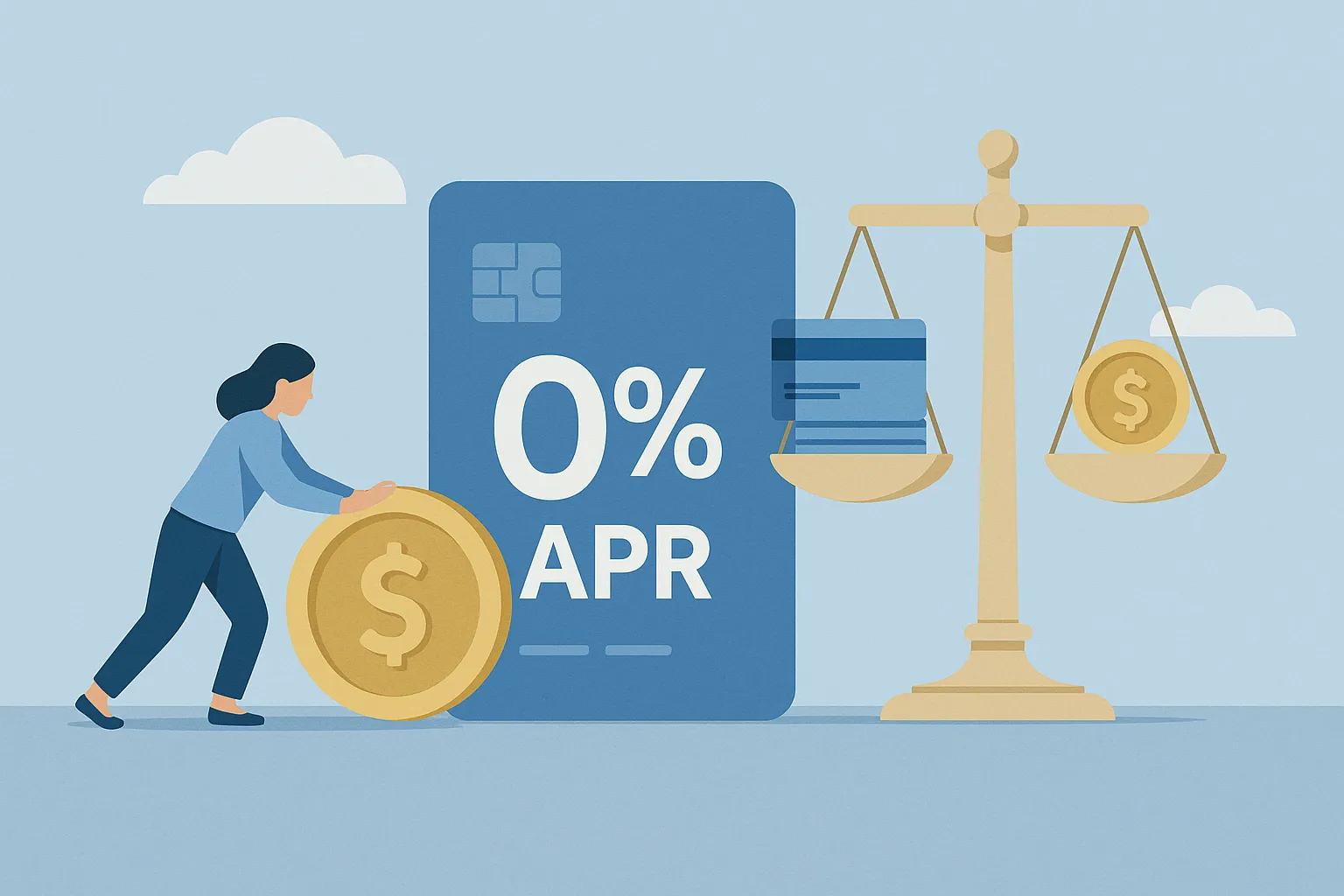
Balance transfer cards and personal loans can both accelerate payoff by lowering your interest rate. A balance transfer to a card offering 0% APR for 15 to 21 months lets every dollar of payment attack principal directly, with no interest drag. The catch: transfer fees are typically 3% to 5% of the balance, and you need good enough credit to qualify. A personal loan at, say, 12% APR is less glamorous than 0%, but it's fixed, predictable, and still beats 22% by a wide margin. Either path works. The key is not using the freed-up card to rack up new charges, which is how people end up deeper in debt after a transfer.
Should you build an emergency fund before attacking debt?
Yes, but a small one. A $500 to $1,000 buffer prevents the car-repair-back-to-credit-card cycle that derails so many payoff plans. You don't need six months of savings before you start. You need enough to not immediately relapse.
Let's talk about the emergency fund objection. A lot of people hear 'put every extra dollar toward debt' and worry about having nothing left if an unexpected bill hits. That's a fair concern. My suggestion: build a small buffer, maybe $500 to $1,000 in a savings account, before going full throttle on debt payoff. This prevents the cycle where an unexpected $400 car repair forces you back onto the credit card you were trying to pay down. A thin emergency fund is not a luxury. It's a structural necessity for getting out of debt without slipping back in.
The concrete next steps to stop the minimum payment cycle
Know your numbers, set a fixed payment above the minimum, automate it, and don't touch the card. That's genuinely it. The plan isn't complicated. The execution is where most people need discipline.
Getting out of debt is not a single decision. It's a series of small, consistent actions taken over months. Start by knowing your exact balance, your exact APR, and your exact minimum payment calculation. Then pick a fixed monthly payment you can sustain, one that's meaningfully higher than the minimum, and automate it. Put the minimum payment warning from your statement somewhere visible. Set a payoff date and work backward. None of this requires a financial advisor or a complicated spreadsheet. It requires honesty about where you are and a commitment to stop letting the minimum feel like enough.