Why most people are leaving money on the table
Skipping your monthly statement review is one of the costliest passive habits in personal finance. Errors, fraud, and fees go unchallenged simply because no one looked. It takes fifteen minutes to fix that.
Most people treat their monthly bank statement like junk mail. They glance at the balance, confirm the number feels roughly right, and toss it. Honestly, that habit is one of the most expensive financial mistakes you can make. Errors happen more than you'd think. Duplicate charges, mystery fees, and unauthorized transactions show up on statements every day, and most of them go unchallenged simply because no one reads carefully enough. The good news is that reviewing a statement thoroughly takes about fifteen minutes once you know what to look for.
What is actually on your bank statement?
A bank statement is a month-by-month record of every transaction, fee, and balance change in your account. Credit card statements add interest charges, your credit limit, and the minimum payment due. Understanding the structure first makes spotting problems much easier.
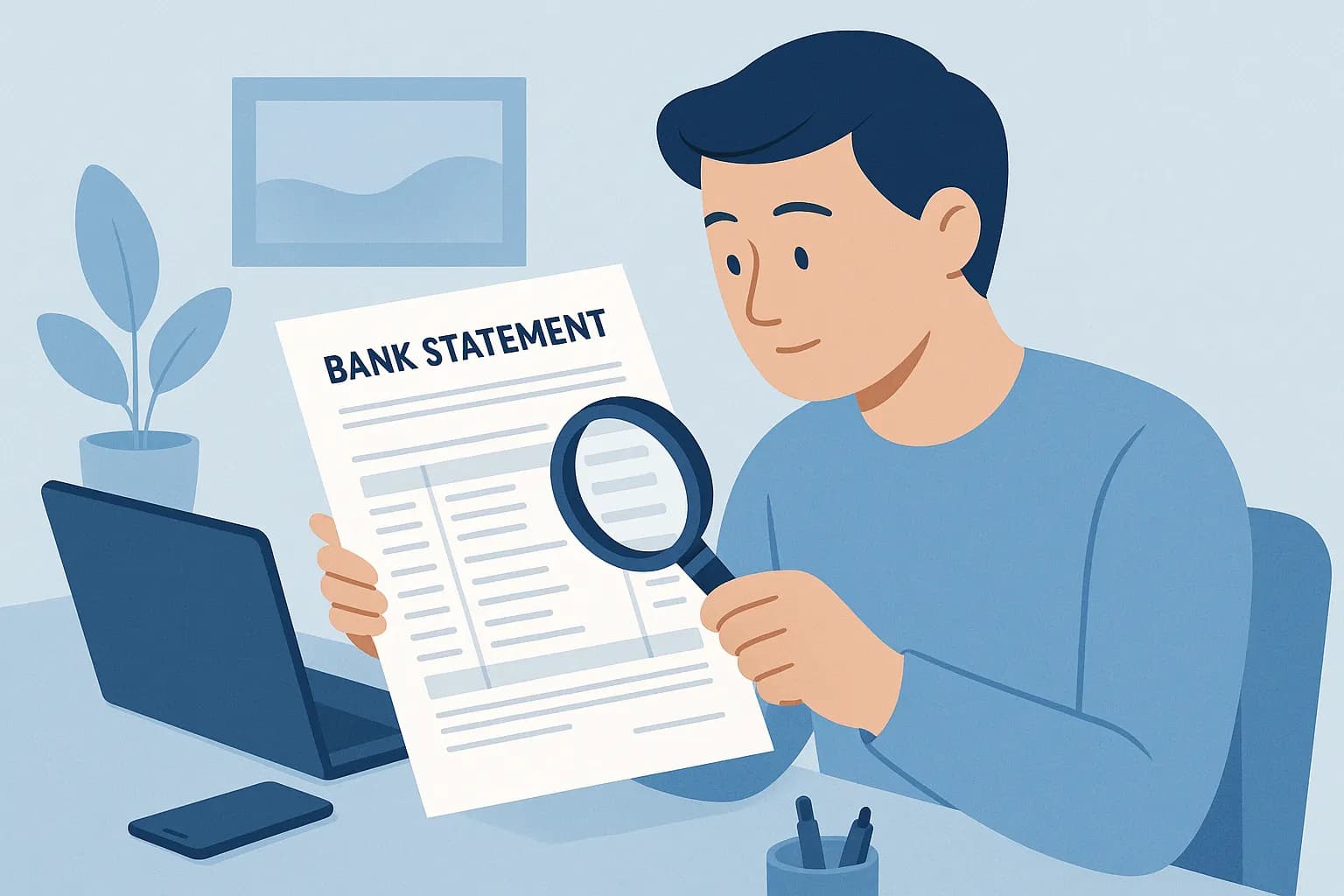
Before you can spot what's wrong, you need to understand what you're looking at. A bank statement is a monthly snapshot of every transaction in your account during a specific period, typically a calendar month. It shows your opening balance, every deposit and withdrawal, any fees charged by the bank, and your closing balance. Credit card statements follow a similar structure but also include your credit limit, minimum payment due, payment due date, and an interest charge summary. The statement period matters because it determines which transactions are grouped together and where the cutoff falls for billing cycles.
Here's a habit worth building: reconcile your statement against your own records. If you use a budgeting app or a simple spreadsheet, compare every transaction line by line against what you already know happened. This sounds tedious, but most people have fewer than 40 transactions per month. At a pace of five seconds per line, that's under four minutes. What you're hunting for is anything that doesn't match, any charge you don't recognize, any amount that looks slightly off. That last one is subtle. Fraudsters sometimes test stolen card numbers with tiny charges, often one dollar or less, before making larger unauthorized purchases. A quick scan misses those. A careful line-by-line review catches them.
Common bank errors that actually cost you money
Double postings, wrong charge amounts, and misapplied deposits are all real and more common than banks like to admit. Federal law requires banks to investigate errors you report, but you have to report them first.
Common bank errors fall into a few predictable categories. Double postings are among the most frequent, where a single transaction appears twice, usually when a merchant's system hiccups during processing. Wrong amounts are another one, where a charge posts for a different figure than what you actually spent. Sometimes a deposit is credited to the wrong account entirely, meaning money you sent or received lands somewhere it shouldn't. These aren't hypothetical edge cases. The CFPB receives thousands of bank account error complaints every year. Banks are required to investigate errors you report in writing, and they have to resolve most disputes within 45 business days under the Electronic Fund Transfer Act.
Hidden fees: what to look for and how to push back
Monthly maintenance fees, overdraft fees, paper statement fees, and out-of-network ATM charges can add up to real money each year. Many of them are waivable if you catch them and ask.
Hidden fees are a category unto themselves. Monthly maintenance fees, paper statement fees, out-of-network ATM fees, overdraft fees, minimum balance fees, and foreign transaction fees can quietly drain your account. Some of these you agreed to in the fine print of your account terms. Others may have appeared because the bank changed its fee schedule and sent you a notice you didn't see. Either way, you're allowed to ask. Call customer service, reference the specific fee line on your statement, and ask for an explanation. If it turns out you're being charged for a paper statement when you never requested one, or for a service you didn't sign up for, dispute it. Many banks will waive fees, especially for customers with a long account history, if you simply ask.
Spotting fraud: the time windows that determine your liability
Report unauthorized credit card charges within 60 days of the statement date and your liability is generally capped. For debit cards, the clock moves even faster. Waiting costs you real money and real legal protection.
Spotting fraud early is the most financially critical reason to read your statement. Unauthorized charges are easiest to fight when you catch them fast. Under the Fair Credit Billing Act, if you report a fraudulent credit card charge within 60 days of the statement date, your liability is generally limited. For debit cards and electronic transfers, the rules under the Electronic Fund Transfer Act are slightly stricter. Report within two business days and your liability cap is $50. Wait two to 60 days and the cap rises to $500. Wait longer than 60 days and you could be on the hook for everything. Those time windows move fast. This is the single strongest argument for reading your statement every month, without fail.
How to dispute a charge: the right way to do it
Start with a written dispute sent to the correct address within the legal timeframe. Follow up by phone to confirm receipt, and keep copies of everything. The process is more straightforward than most people expect.
If you find something wrong, whether it's a bank error, an unauthorized charge, or a fee you shouldn't have been charged, the dispute process starts with a written notice. For credit cards, send a written dispute to the billing address listed on your statement within 60 days of the statement that shows the charge. For bank account errors, notify your bank in writing as soon as possible. Keep a copy of everything you send. The bank is then required to acknowledge your complaint and investigate. During the investigation, you generally don't have to pay the disputed amount on a credit card, though interest may continue to accrue on the rest of your balance. I'd also follow up any written dispute with a phone call, just to confirm receipt, and document the name of whoever you speak with.
Your statement as a spending mirror
Three months of statements reveal patterns you'd never notice transaction by transaction. This isn't about guilt. It's about seeing clearly so you can make better choices.
Your statement also tells a story about your habits. Pull up three months of statements and you'll see patterns you might not notice transaction by transaction. Subscription services you forgot about. Restaurant spending that's crept upward. Impulse purchases clustered around specific weekends. This isn't about shame. It's about information. You can't adjust spending you can't see clearly. The statement is the clearest financial mirror you have, and most people never look at it carefully enough to actually learn something. I'd treat this part of the monthly review as a five-minute budget check, not a judgment session.
One more thing worth flagging: your credit card statement's interest charge summary. This section tells you exactly how much interest you paid last month on your average daily balance. On a $5,000 balance at 20% APR, you might be paying over $80 in interest charges every single month, which is money that goes entirely to the lender and builds nothing for you. Seeing that number written out in black and white is often more motivating than any budgeting advice. It makes the cost of carrying a balance concrete. If you've been planning to pay down a card, that line item is the most persuasive argument in favor of doing it sooner.
Build the 15-minute monthly review habit
Set a recurring calendar reminder a few days after your statement closes. Reconcile, scan for fraud and errors, note spending patterns. If something's wrong, file the dispute immediately and use the legal protections available to you.
The review habit is the point. Set a recurring calendar reminder for the same date each month, maybe three days after your statement closes. Open the statement, reconcile your transactions, scan for unknown charges or fees, check the interest summary if it's a credit card, and note any patterns worth adjusting. That's it. Fifteen minutes, once a month. If you find an error, dispute it in writing immediately and follow the timelines in the law. If you find fraud, report it to your bank and, if needed, to the FTC at ReportFraud.ftc.gov. Don't wait, don't assume it'll sort itself out. The protections exist to help you, but only if you use them inside the required windows.