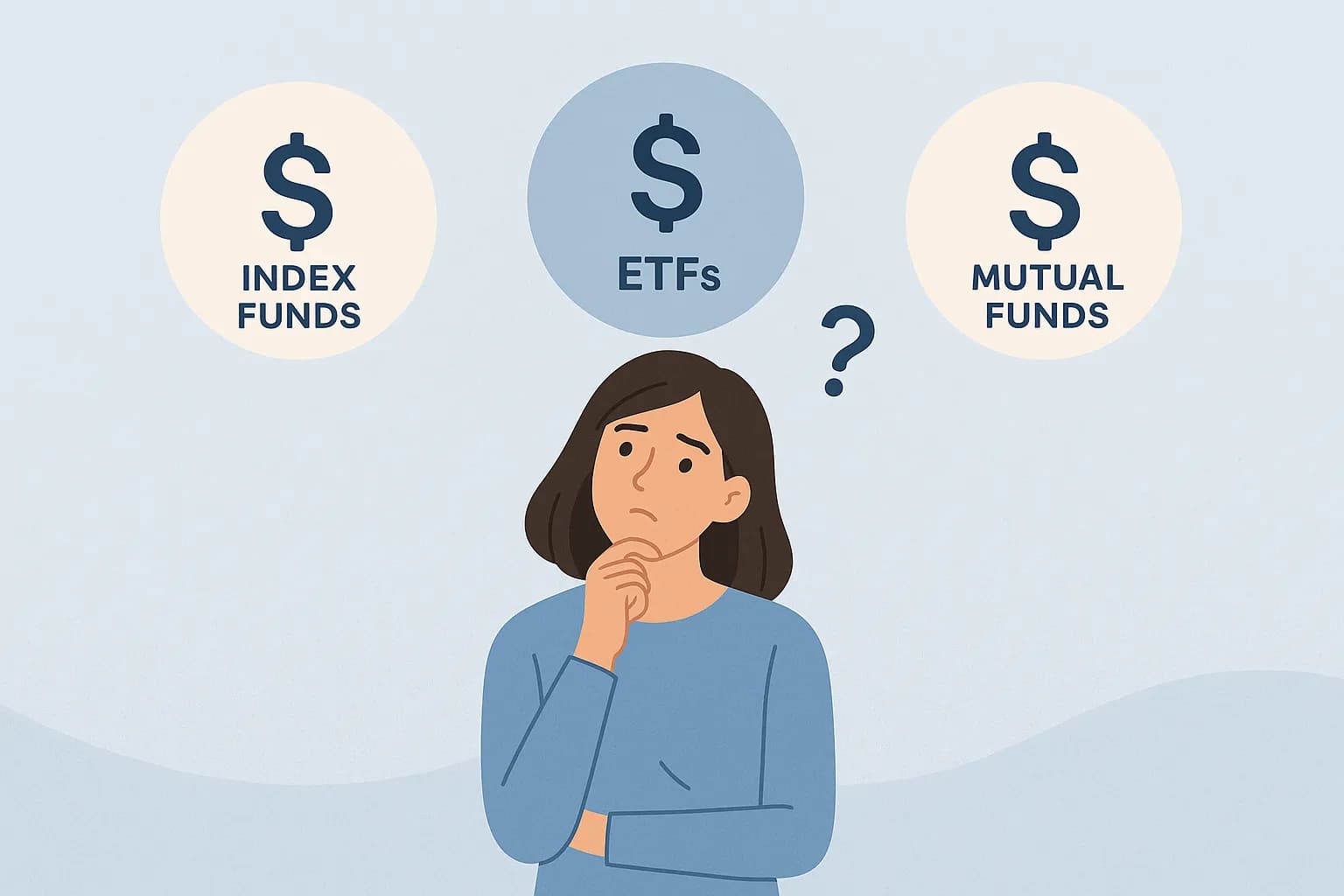
Why are index funds, ETFs, and mutual funds so confusing?
They're confusing because the terms genuinely overlap. An index fund can be an ETF or a mutual fund. Once you understand that structure and strategy are two different things, it clicks fast.
If you've ever typed 'how do I start investing' into a search bar and ended up more confused than when you started, you're not alone. The investment world loves its jargon. ETFs, NAV, expense ratios, load funds, passive management. It piles up fast. But here's the thing: you don't need to understand all of it to make a smart first move. You need to understand three things well, and that's exactly what this guide covers. Index funds, ETFs, and mutual funds are the three most common investment vehicles for everyday Americans. They're related, they overlap in important ways, and yes, one of them is probably the right fit for where you are right now.
Let's get the big conceptual clarity out of the way first. A mutual fund is a pool of money collected from many investors and managed by a professional (or a team) to buy a collection of stocks, bonds, or other assets. An ETF, which stands for exchange-traded fund, is also a pool of investor money that holds a collection of assets, but it trades on a stock exchange throughout the day, just like a share of Apple or Amazon. An index fund isn't a separate structure so much as a strategy. It refers to any fund, whether a mutual fund or an ETF, that tracks a market index like the S&P 500 instead of trying to beat the market. So you can have an index mutual fund or an index ETF. These terms overlap, and that's what trips people up.
How do mutual funds, ETFs, and index funds actually work?
Mutual funds are priced once daily and bought directly from the fund company. ETFs trade on a stock exchange like individual stocks. Index funds are either one, just following a passive strategy instead of active stock-picking.
Why does this distinction matter? Because the structure of a fund affects how you buy it, how much it costs, and how you're taxed. Mutual funds are priced once per day, after markets close, and you buy them directly from a fund company like Vanguard or Fidelity. ETFs are bought and sold during market hours through a brokerage account, just like stocks. That means ETFs require a brokerage account, and some older or smaller brokerages used to charge a trading commission for each purchase. Most major brokerages eliminated ETF commissions around 2019 and 2020, so that's less of a concern now, but it's worth confirming before you open an account.
Costs matter more than almost anything else
Expense ratios are the fee you pay annually as a percentage of your balance. Actively managed funds charge 10 to 50 times more than index funds. Over decades, that gap compounds into a massive difference.
Costs are, honestly, the most important variable you can control as an investor. You can't predict market returns. You can control what you pay to invest. The main cost metric to watch is the expense ratio, which is the annual fee a fund charges, expressed as a percentage of your investment. A fund with a 0.03% expense ratio costs you $3 per year on a $10,000 investment. A fund with a 1.0% expense ratio costs you $100 per year on the same balance. That gap sounds small, but over 30 years of compounding, the difference can be tens of thousands of dollars. Actively managed mutual funds, where a professional stock picker tries to beat the market, tend to carry expense ratios in the 0.5% to 1.5% range. Index funds and index ETFs often charge 0.03% to 0.20%. The research is clear: most active managers don't outperform their benchmark index over long time horizons after fees are accounted for. So for most beginners, lower-cost passive investing wins.
Beyond expense ratios, some mutual funds charge a 'load,' which is a sales commission paid when you buy (front-end load) or sell (back-end load). A 5% front-end load means $500 of your $10,000 investment goes to the broker before a single dollar is invested. No-load funds exist and are widely available through direct fund companies and major brokerages. If someone tries to sell you a load fund as your first investment, I'd push back hard. There are excellent no-load options everywhere. ETFs, for their part, don't have traditional loads, but you should check for bid-ask spreads (the tiny difference between the buy and sell price) on less-traded ETFs. For major index ETFs from Vanguard, Fidelity, or Schwab, this spread is negligible.
ETFs have a tax efficiency edge in taxable accounts
In a regular brokerage account, ETFs are generally more tax-efficient than mutual funds because of how they handle investor redemptions. Inside a Roth IRA or 401(k), this difference barely matters.
Tax efficiency is one area where ETFs tend to edge out traditional mutual funds, especially in taxable brokerage accounts. When you invest in a mutual fund and other investors redeem their shares, the fund may have to sell underlying holdings and distribute capital gains to all shareholders, including you, even if you didn't sell a single share. You get a tax bill for someone else's decision. ETFs use a different redemption mechanism (called in-kind creation and redemption) that largely avoids this problem. Index mutual funds are also fairly tax-efficient because they trade less than active funds, but the ETF structure still has a structural edge here. If you're investing inside a tax-advantaged account like a Roth IRA or 401(k), this difference mostly disappears since you're not paying taxes on gains annually anyway.
Which one should a beginner actually choose?
For a 401(k), you'll pick from mutual funds on the plan's menu. For your own IRA or brokerage account, I'd lean toward a low-cost index ETF from a major provider. Either way, prioritize low expense ratios and broad diversification.
So which one should you actually start with? Here's my honest take. If your first investment account is a 401(k) through your employer, you likely don't have a choice between ETFs and mutual funds. Most 401(k) plans offer a menu of mutual funds, and you pick from what's available. Look for index funds with the lowest expense ratios on that list. If you're opening your own IRA or taxable brokerage account, I'd lean toward a low-cost index ETF from a major provider. The Vanguard Total Stock Market ETF (VTI) or the Fidelity ZERO Total Market Index Fund are two commonly cited examples of low-cost, broadly diversified options. The key word is 'broadly diversified.' One fund that holds thousands of companies beats trying to pick individual stocks, especially when you're just starting out.
One real consideration for beginners is minimum investment requirements. Some mutual funds require you to invest a minimum of $1,000 or even $3,000 to get started. ETFs have no minimum beyond the price of a single share, and many brokerages now offer fractional shares, so you can invest $5 or $50 with no barrier. Fidelity, for example, eliminated minimums on many of its index mutual funds entirely. So if you have $500 to start, check whether the fund you want has a minimum. This is a practical detail that trips up a lot of first-time investors who get excited, try to open an account, and hit a wall at the funding step.
Don't let the perfect choice stop you from investing
The gap between a great low-cost index fund and a slightly different great low-cost index fund is tiny. The gap between investing and not investing is enormous. Pick something reasonable and start.
Here's what I'd say to someone who's paralyzed by the choice: don't let perfect be the enemy of good. A broadly diversified, low-cost index ETF or index mutual fund is a sound starting point by almost any measure. The difference in long-term outcome between a Vanguard index ETF and a Fidelity index mutual fund is trivial compared to the difference between investing nothing and investing something. Pick a brokerage with no account minimums and no trading commissions (Fidelity, Schwab, and Vanguard are the usual starting points), open an account, and put money in a total-market or S&P 500 index fund. That's it. Revisit fees and tax strategy once you've got $5,000 or $10,000 invested and have a sense of what you're doing.
Your first four steps to get started
Choose your account type, pick a brokerage, select a low-cost index fund, and automate contributions. That's the full playbook for a first-time investor.
Your next move is straightforward. First, figure out what account type fits your situation: a 401(k) through work, a Roth IRA if you have earned income and are within the income limits, or a taxable brokerage account if you've already maxed out tax-advantaged options. Second, pick a brokerage if you're opening your own account. Look for no account minimums, commission-free trades, and a selection of low-cost index funds. Third, choose a fund. For most beginners, a total market or S&P 500 index fund with an expense ratio below 0.10% is hard to beat. Fourth, set up automatic contributions if you can. Even $50 a month, invested consistently, builds the habit and lets compounding do its work over time. You don't need to know everything to start investing. You need to know enough to avoid the obvious pitfalls, and now you do.