Why $100 is enough to start investing right now
The barriers to investing have genuinely collapsed. You don't need thousands of dollars, a broker, or a financial advisor to begin. You need $100 and an account.
Most people believe investing is something you do after you've 'made it.' After the raise, after the debt is paid, after you've got a comfortable cushion. Here's the thing: that mindset is exactly what keeps people from building wealth in the first place. The truth is, you don't need a financial advisor, a brokerage account minimum, or a windfall to start. You need $100 and a willingness to begin. That's it. The financial industry has changed more in the last decade than in the previous fifty years, and the biggest shift is this: the barriers to entry have collapsed. Fractional shares, no-minimum accounts, and zero-commission trades mean anyone with a smartphone and a few spare dollars can own a piece of the global economy. If you've been waiting for the 'right time' or the 'right amount,' stop waiting. Now is exactly the right time.
Compound growth is why starting early matters more than starting big
Time is your most valuable asset as an investor. A small amount invested today grows more than a large amount invested years from now.
Before you buy a single share of anything, you need to understand what compound growth actually does for you over time. Not in vague 'money makes more money' terms, but concretely. If you invest $100 today and earn an average annual return of 7% (a reasonable long-run expectation for a diversified stock portfolio, though not a guarantee), in 30 years that $100 becomes roughly $760 without you doing another thing. Add $50 a month to that initial $100, and you're looking at something closer to $60,000 over the same period. The math isn't magic. It's just time working in your favor. And here's what stings: every year you wait is a year that time isn't working. A 25-year-old and a 35-year-old investing identical amounts end up in very different places at 65, not because of skill, but because of a ten-year head start. Start now, even if 'now' means a modest $100.
Which account type should you open first?
For most beginners, I'd lean toward a Roth IRA if you're income-eligible. Tax-free growth over decades is hard to beat, and you can access your contributions in a pinch.
There are three main account types worth knowing when you're just starting out. A taxable brokerage account gives you full flexibility: invest in anything, withdraw anytime, no restrictions. The downside is you'll owe capital gains taxes on your profits. A Roth IRA, on the other hand, lets your money grow tax-free and you can withdraw contributions (not earnings) anytime without penalty. Contributions are limited to $7,000 per year in 2024 for those under 50, and your income must fall under certain thresholds set by the IRS. A Traditional IRA gives you a tax deduction now and you pay taxes on withdrawals later. For most people starting with $100, I'd lean toward a Roth IRA if you qualify. The tax-free growth over decades is genuinely valuable, and you don't lose access to your contributions in a true emergency.
Where should you actually open your account?
Robo-advisors are great if you want everything handled for you. Self-directed brokerages like Fidelity or Schwab are better if you want to learn and stay hands-on. Both beat doing nothing.
Once you've chosen an account type, you need somewhere to open it. Robo-advisors like Betterment or Wealthfront build and manage a diversified portfolio for you automatically, usually for an annual fee of around 0.25% of your balance. That's $0.25 per year on your first $100, which is essentially nothing. Traditional online brokerages like Fidelity and Charles Schwab now offer $0 account minimums and commission-free trades, with access to thousands of funds and individual stocks. If you want the simplest possible experience, a robo-advisor makes sense. If you want to learn more and make your own choices, a self-directed brokerage account gives you that room to grow. Both are solid options. The wrong choice is doing nothing because you can't decide between them.
What should you actually buy with your first $100?
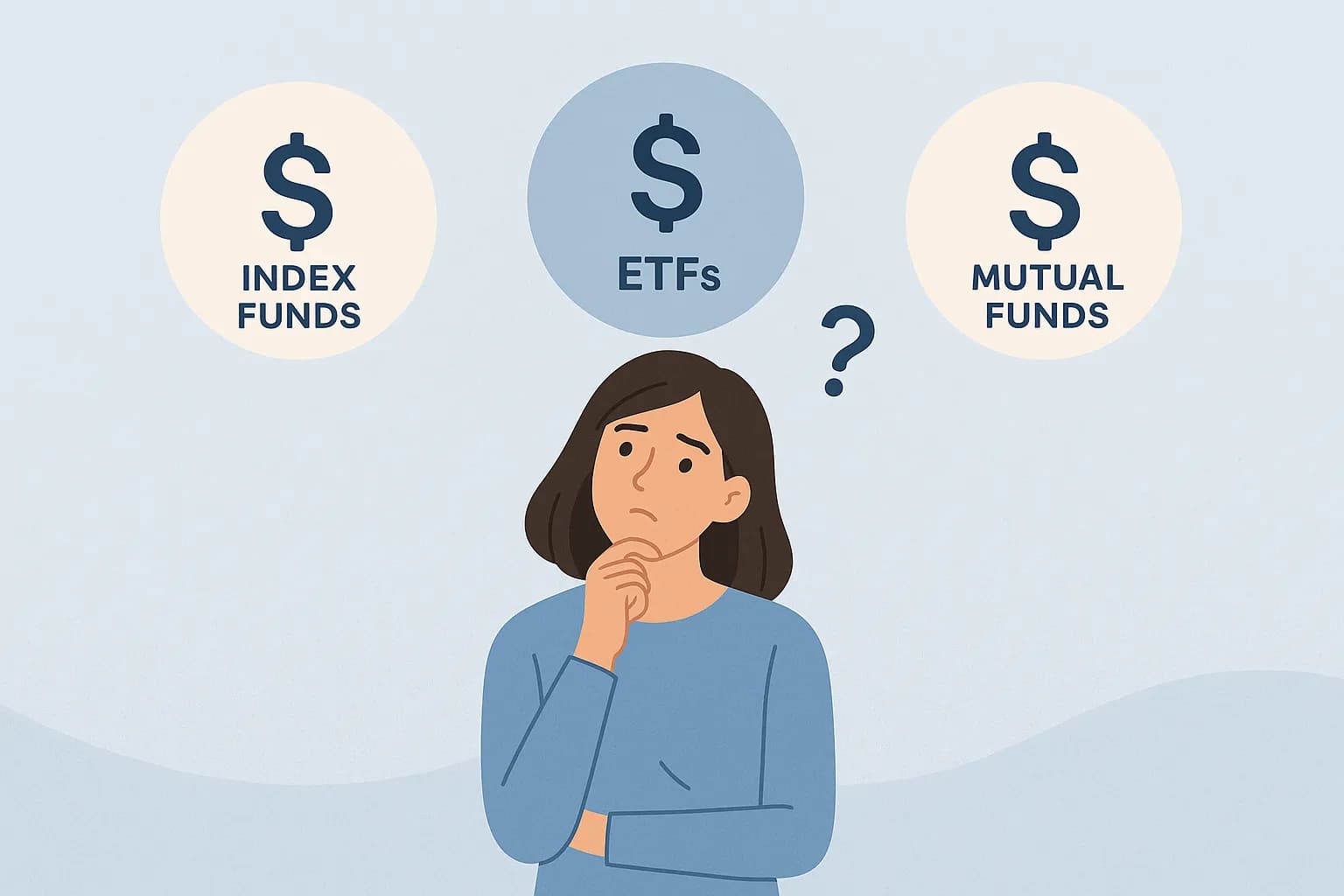
One low-cost index fund or ETF is the right answer for almost every beginner. You get instant diversification without needing to pick individual stocks.
With $100, you're not buying a diversified portfolio of individual stocks. You'd need hundreds of thousands of dollars for that. What you can do is buy a single index fund or ETF (exchange-traded fund) that already owns hundreds or thousands of companies. A total stock market index fund, for example, holds thousands of U.S. stocks in a single purchase. A broad international fund adds global exposure. These funds track an index passively, which keeps costs low. Look for funds with expense ratios below 0.20%. Some, like Fidelity's zero-expense-ratio index funds, charge nothing at all. This isn't settling for a second-best option. Decades of research from institutions including Vanguard consistently show that low-cost index funds outperform most actively managed funds over long time horizons. Start simple. A single total-market index fund is a genuinely excellent choice for a first investment.
Fractional shares make any stock accessible on a $100 budget
Fractional shares let you buy a slice of any stock or ETF for as little as $1, so a $300 stock price is no longer a barrier. They also make dollar-cost averaging much easier.
Fractional shares changed everything for new investors. Before fractional shares became mainstream, buying into certain large companies meant spending hundreds or thousands of dollars on a single share. Now, platforms like Fidelity, Schwab, and several robo-advisors let you buy a fraction of a share for as little as $1. So if a company's stock trades at $300 per share, you can invest $50 and own one-sixth of a share. For a beginner with $100, this opens up the entire market. You're no longer locked out of high-priced stocks or expensive ETFs. More importantly, fractional shares let you practice dollar-cost averaging: investing a fixed dollar amount at regular intervals regardless of price. This approach smooths out volatility over time and removes the pressure of trying to time the market, which even professional fund managers consistently fail to do well.
How much risk are you actually taking on?
Stocks go down, sometimes sharply. If you need the money in under three years, it doesn't belong in the market. If you have a decade or more, short-term drops are manageable.
Let's talk about risk, because it's real and you deserve a straight answer on it. Stock markets go down. Sometimes they go way down. During the 2008 financial crisis, the S&P 500 dropped roughly 57% from its peak before recovering. During the COVID-19 crash in early 2020, markets fell about 34% in about five weeks. Both times, they recovered and went on to reach new highs, but that process took time. For a long-term investor in their 20s or 30s, this is uncomfortable but manageable. For someone who needs the money in two years, it's a real problem. The general rule: money you need within three to five years shouldn't be in the stock market. Keep that in a high-yield savings account instead. Money you won't touch for a decade or more is where stocks make sense. Understand your timeline before you invest a dollar.
Check your employer match before opening anything else
If your employer matches 401(k) contributions and you're not capturing the full match, that's your first move. It's the closest thing to free money in personal finance.
One of the genuinely underused tools available to new investors is employer matching. If your job offers a 401(k) with an employer match and you aren't contributing enough to capture the full match, that's the first move to make, even before opening a separate brokerage account. A 50% match on the first 6% of your salary is a 50% guaranteed return on that portion of your contribution, which no investment can reliably beat. Before you debate index funds versus ETFs or Roth versus Traditional, check whether you're leaving employer match money on the table. If you are, redirect whatever you were going to invest in your first $100 toward hitting that match threshold first. Then open your external account with whatever's left.
The biggest threat to your returns is your own behavior
Checking your portfolio daily and selling during downturns costs real money over time. Automate contributions, hold through volatility, and review quarterly, not constantly.
Honestly, the hardest part of investing isn't picking the right fund. It's doing it and then leaving it alone. The behavioral economics research is consistent: individual investors who trade frequently underperform those who invest and hold. Checking your portfolio daily, panicking during downturns, and switching strategies every few months all chip away at returns. Set up automatic contributions if you can, even $25 a month. Automate the investment so it happens before you have a chance to spend the money elsewhere. And when markets drop, resist the urge to sell. A down market is just a sale on investments you already planned to own. The investor who stays the course through volatility consistently outperforms the one who tries to dodge every dip.
Your six-step action plan to invest your first $100 today
Open a Roth IRA or brokerage account, fund it with $100, buy a total-market index fund, set up automatic contributions, and review it once a quarter. That's the whole plan.
Here's your actionable starting point, simplified to a single afternoon's work. Step one: choose an account type. A Roth IRA is my recommendation for most people starting out, assuming you have earned income and fall under the IRS income limits. Step two: open the account. Fidelity and Schwab both have no minimums and strong educational resources for beginners. Step three: fund the account with your $100 and set up a recurring monthly transfer, even if it's only $25 or $50. Step four: buy a total stock market index fund with an expense ratio under 0.20%. Step five: turn on dividend reinvestment if your platform offers it. Step six: set a calendar reminder to review your account once a quarter, not once a week. That's it. You're an investor now. The version of you ten or twenty years from now will be grateful you didn't wait another month to get started.