Why does everyone misunderstand tax brackets?
The myth that a raise can leave you worse off financially is widespread and completely false. It persists because the progressive tax system sounds counterintuitive until someone actually walks you through the math.
Here's a question I hear constantly: 'If I get a raise, will I end up taking home less money?' The answer is no. Never. But the fear is understandable, because the way tax brackets work is genuinely confusing, and most of us were never taught it properly. The U.S. federal income tax system is progressive, meaning higher rates apply only to the portion of your income that falls within each bracket, not to every dollar you earn. Once you understand that one principle, the whole system clicks into place.
The confusion often comes from the way people talk about tax brackets in everyday conversation. Someone says 'I'm in the 24% bracket' and it sounds like every dollar they earn is taxed at 24%. It's not. That phrasing is shorthand for 'my top tier of income is taxed at 24%.' The distinction is enormous, and clearing it up changes how you think about raises, side income, bonuses, and retirement contributions all at once.
What exactly is a tax bracket?
A tax bracket is an income range with its own specific rate. The U.S. has seven brackets in 2024, ranging from 10% to 37%, and they only apply to the slice of income that falls within each range.
A tax bracket is simply a range of taxable income that gets taxed at a specific rate. For the 2024 tax year, the IRS uses seven brackets: 10%, 12%, 22%, 24%, 32%, 35%, and 37%. These rates are set by Congress and adjusted slightly each year for inflation. The brackets themselves are not arbitrary. They reflect a deliberate policy choice: people with lower incomes keep a larger share of each dollar they earn, while people with very high incomes pay a higher rate on the portion of income above each threshold.
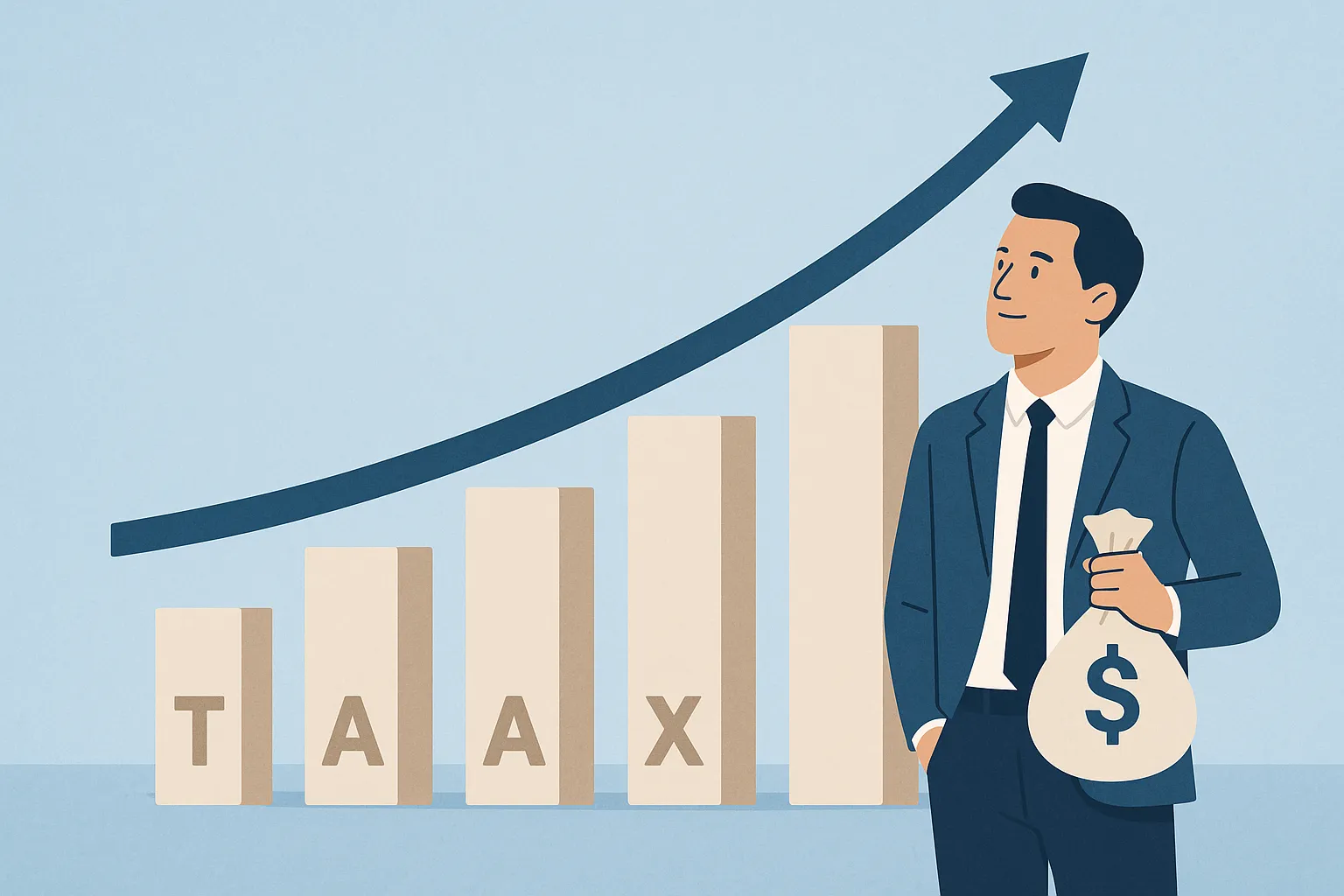
Here is where most people go wrong. They hear '22% tax bracket' and assume every dollar they earn gets taxed at 22%. That's not how it works. Only the dollars that fall within the 22% bracket get taxed at 22%. Your first dollars of taxable income get taxed at 10%, the next tier at 12%, and so on up the ladder. Think of it like stacking buckets. Each bucket fills up before income spills into the next one, and each bucket has its own tax rate. Your top rate, the one that applies to your last dollar of income, is your marginal rate.
Taxable income is not your gross salary
Before the brackets even touch your money, deductions reduce your taxable income. For most people, the standard deduction alone knocks thousands off the number that gets taxed.
Taxable income is not the same as your gross salary. This distinction matters more than most people realize. Before income taxes are applied, you first subtract your standard deduction (or itemized deductions if they exceed the standard amount) and any other above-the-line adjustments you qualify for. For 2024, the standard deduction is $14,600 for single filers and $29,200 for married couples filing jointly, according to the IRS. If you earn $60,000 as a single filer and take the standard deduction, your taxable income drops to $45,400. That is the number that actually gets sorted through the brackets.
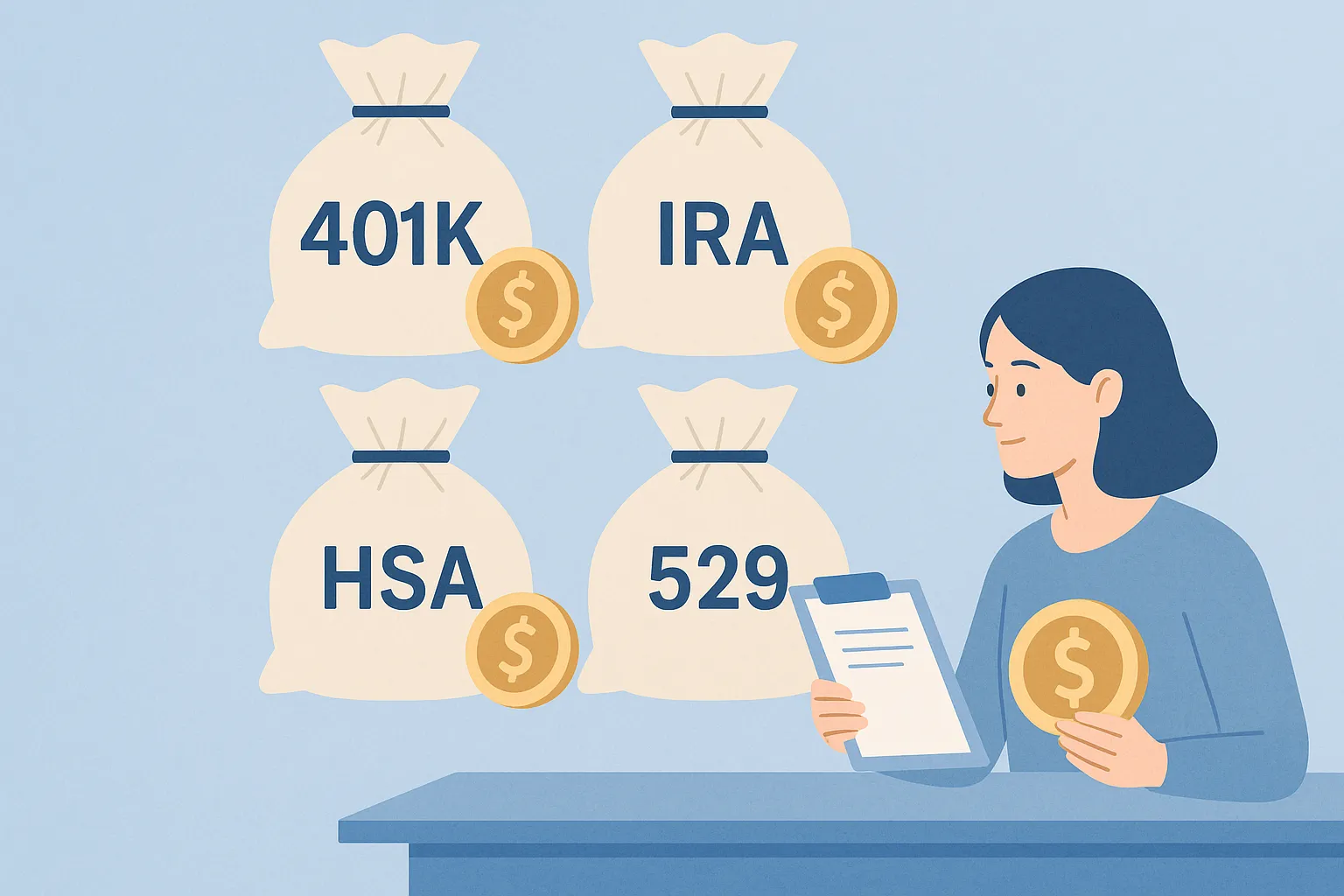
Pre-tax contributions matter here too. If you contribute $5,000 to a traditional 401(k), that money comes out of your taxable income before the IRS calculates your bracket placement. So the same $60,000 earner contributing $5,000 to a 401(k) has taxable income of $40,400 after the standard deduction. That can keep a meaningful chunk of income in a lower bracket and is one of the most straightforward legal tax reduction tools available to working Americans.
A real example: walking through the 2024 brackets
Let's do the actual math. Once you see the numbers laid out, the logic becomes obvious and you'll never misread your tax situation again.
Let's walk through a concrete example using 2024 single-filer brackets. Suppose your taxable income is $50,000. The first $11,600 is taxed at 10%, which is $1,160. Income from $11,601 to $47,150 is taxed at 12%, which covers $35,550 of income and produces $4,266 in tax. The remaining $2,850 (from $47,151 to $50,000) falls in the 22% bracket, adding $627. Your total federal income tax is roughly $6,053. That is your marginal rate sitting at 22%, but your effective rate, the actual percentage of your total income paid in taxes, is only about 12.1%. Two very different numbers.
Now suppose you get a $5,000 raise, bringing taxable income to $55,000. That entire $5,000 falls in the 22% bracket, costing $1,100 in additional federal tax. You keep $3,900 of it. Your marginal rate didn't change, your effective rate ticked up slightly, and you are unambiguously better off. The raise never hurt you. This is why I find the 'I don't want to earn more and lose my bracket' fear so worth addressing directly. The math simply doesn't support it.
Marginal rate vs. effective rate: which one actually matters?
Your marginal rate tells you the cost of the next dollar you earn or the value of your next deduction. Your effective rate tells you your actual tax burden. Both are useful, but for different decisions.
The effective tax rate is, honestly, the more useful figure for everyday financial planning. It tells you what fraction of your income actually goes to the federal government. High earners often cite their marginal rate as a way to describe their tax burden, but the effective rate paints a more accurate picture. A single filer with $200,000 in taxable income in 2024 sits in the 32% bracket for their top dollars, but their effective rate will be closer to 22% to 24% once you account for the lower rates applied to the first six figures of income. The marginal rate is the ceiling, not the average.
Understanding your marginal rate matters because it tells you the after-tax value of additional income or the after-tax cost of deductions. If you're in the 22% bracket, an additional $1,000 deduction saves you $220 in federal taxes. A $1,000 raise nets you $780 after federal tax (ignoring state taxes and FICA). This is exactly the math you need when deciding whether to make a pre-tax 401(k) contribution, take on a side project, or evaluate whether itemizing beats the standard deduction. The marginal rate is your decision-making rate.
Brackets adjust for inflation every year
The IRS shifts bracket thresholds upward each year to prevent inflation from quietly pushing people into higher rates. This is called indexing, and it protects moderate earners from what's known as bracket creep.
Tax brackets also adjust each year for inflation, and this is worth knowing. The IRS uses a measure called the Chained Consumer Price Index to set bracket thresholds annually. Without these adjustments, inflation alone would push people into higher brackets even without any real increase in purchasing power. This phenomenon is called bracket creep. Because the IRS indexes brackets, a modest cost-of-living raise typically does not move you into a meaningfully different tax situation. Your paycheck is larger, your taxable income is a bit higher, but the brackets have shifted upward to meet you.
This indexing has real value for middle-income households. If you received a 4% raise in a year when inflation ran at 4%, your real purchasing power held steady, and indexed brackets mean your effective tax rate should hold roughly steady too. Without indexing, you'd owe more in taxes despite being no richer in real terms. The IRS publishes updated bracket thresholds each fall, usually in October or November, for the following tax year. It's worth a quick look whenever you're doing end-of-year tax planning.
Capital gains are taxed differently from ordinary income
Investment profits held more than a year get their own lower tax rates, separate from your ordinary income brackets. For most middle-income earners, that rate is 15%, which makes long-term investing meaningfully more tax-efficient.
Capital gains and qualified dividends operate under a separate, parallel rate structure that is worth a brief mention. Long-term capital gains, meaning gains on assets held more than one year, are taxed at 0%, 15%, or 20% depending on your taxable income, not at your ordinary income marginal rate. For most middle-income earners in 2024, the long-term capital gains rate is 15%. This separation is one reason investors in the 22% ordinary income bracket still prefer holding investments for more than a year before selling. The tax savings can be material.
Short-term capital gains, meaning profits on assets sold within a year of purchase, are taxed as ordinary income at your marginal rate. So if you're in the 22% bracket and you sell a stock after holding it 10 months, the profit is taxed at 22%. Hold that same stock for 13 months instead and the rate drops to 15% for most earners. That seven percentage point difference is a meaningful incentive built directly into the tax code to encourage longer-term investment behavior.
What to do next: use the brackets to plan smarter
Knowing your marginal rate gives you a practical tool for real financial decisions, from retirement contributions to freelance income. Here's how to put this knowledge to work.
The practical upshot of all this is liberating. Earning more money never hurts you in net terms. Crossing into a higher bracket means only your income above the threshold faces the new rate, and even then, your after-tax income grows. If you are nervous about a raise, a bonus, or a profitable freelance project pushing you into a new bracket, set that worry aside. What you want to track instead is your effective rate, your deductions, and whether pre-tax contributions to retirement accounts or HSAs could reduce your taxable income. That is where real tax planning lives.
Start by finding your estimated taxable income for the year, which you can calculate by subtracting your standard deduction and any pre-tax contributions from your gross income. Then look up the current IRS bracket thresholds for your filing status. See how close you are to the next bracket line. If a $2,000 traditional IRA contribution would keep a slice of income in the 12% bracket instead of the 22% bracket, that's a $200 difference in taxes. Small adjustments at the margin add up. The IRS Free File program and free tax prep tools like IRS Withholding Estimator can help you model this without paying for professional advice on basic questions.