Why the order you fund tax-advantaged accounts matters
It's not just about contributing to tax-advantaged accounts. It's about doing it in the right sequence, because that sequence determines how much the government takes versus how much compounds for you. The difference over 30 years can be staggering.
Most people know they're supposed to use tax-advantaged accounts. Far fewer know which ones to prioritize, how they interact, or why the order you fund them matters almost as much as the amounts you contribute. Here's the honest truth: the difference between funding these accounts in the right sequence versus the wrong one can add up to tens of thousands of dollars over a career. Not because of some fancy investment strategy. Just because of taxes. So let's fix that.
How does a 401(k) actually work?
A 401(k) lets you contribute pre-tax dollars from your paycheck, up to $23,000 in 2024, and your employer may match part of what you put in. That match is essentially free money, and missing it is a costly mistake.
A 401(k) is an employer-sponsored retirement plan that lets you contribute pre-tax dollars directly from your paycheck. For 2024, the IRS allows you to contribute up to $23,000 per year, with a $7,500 catch-up contribution if you're 50 or older. The money grows tax-deferred, meaning you pay taxes only when you withdraw it in retirement. The real power of a 401(k) is the employer match. If your employer matches 50 cents on every dollar up to 6% of your salary, and you earn $80,000, that's $2,400 in free money annually. Leaving that on the table is one of the most expensive financial mistakes you can make.
Traditional IRA vs. Roth IRA: which one should you choose?
For most people in their 20s and 30s, the Roth IRA wins. You're probably in a lower tax bracket now than you'll be later, so paying taxes today and getting tax-free withdrawals in retirement is usually the smarter trade. Income limits apply, though.
Traditional and Roth IRAs are individual retirement accounts you open yourself, independent of any employer. For 2024, the contribution limit is $7,000 per year ($8,000 if you're 50 or older). The key difference is timing. With a Traditional IRA, you may get a tax deduction now and pay taxes in retirement. With a Roth IRA, you contribute after-tax dollars and your withdrawals in retirement are completely tax-free. I'd lean toward the Roth for most people in their 20s and 30s. You're likely in a lower tax bracket now than you will be later, so locking in today's tax rate on contributions is a smart bet. Income limits do apply to Roth contributions, phasing out between $146,000 and $161,000 for single filers in 2024.
The HSA is the most underused account in the tax code
Honestly, the HSA is the best account most people ignore. It has a triple tax advantage: pre-tax contributions, tax-free growth, and tax-free withdrawals for medical expenses. If you're eligible, fund it aggressively.
The Health Savings Account (HSA) is genuinely the most underappreciated account in the entire tax code. Here's why it's special: contributions are pre-tax, the money grows tax-free, and withdrawals for qualified medical expenses are also tax-free. That's a triple tax advantage no other account offers. For 2024, you can contribute up to $4,150 as an individual or $8,300 for a family. The catch is eligibility. You must be enrolled in a High Deductible Health Plan (HDHP) to open or contribute to an HSA. If you are eligible, I'd fund this account with real enthusiasm. After age 65, you can withdraw for any reason and pay only ordinary income tax, making it function essentially like a Traditional IRA as a backup.
What is a 529 plan and when does it make sense?
A 529 is a tax-free education savings account with growing flexibility, including a new option to roll unused funds into a Roth IRA. If you're saving for a child's education, it's the most tax-efficient vehicle available.
A 529 plan is a state-sponsored education savings account. Contributions are made with after-tax dollars, but the money grows tax-free, and withdrawals are tax-free when used for qualified education expenses. These include college tuition, fees, room and board, and as of recent law changes, up to $10,000 per year for K-12 private school tuition. Thirty-seven states also offer a state income tax deduction or credit for contributions. One important update: thanks to the SECURE 2.0 Act, unused 529 funds can be rolled into a Roth IRA for the beneficiary, subject to a lifetime limit of $35,000. That change removed one of the biggest historical objections to 529s.
The optimal order for funding your accounts
Start with enough in your 401(k) to get the full employer match, then max the HSA, then the Roth IRA, then finish maxing the 401(k), then the 529. Follow the tax math, not the order on the enrollment form.
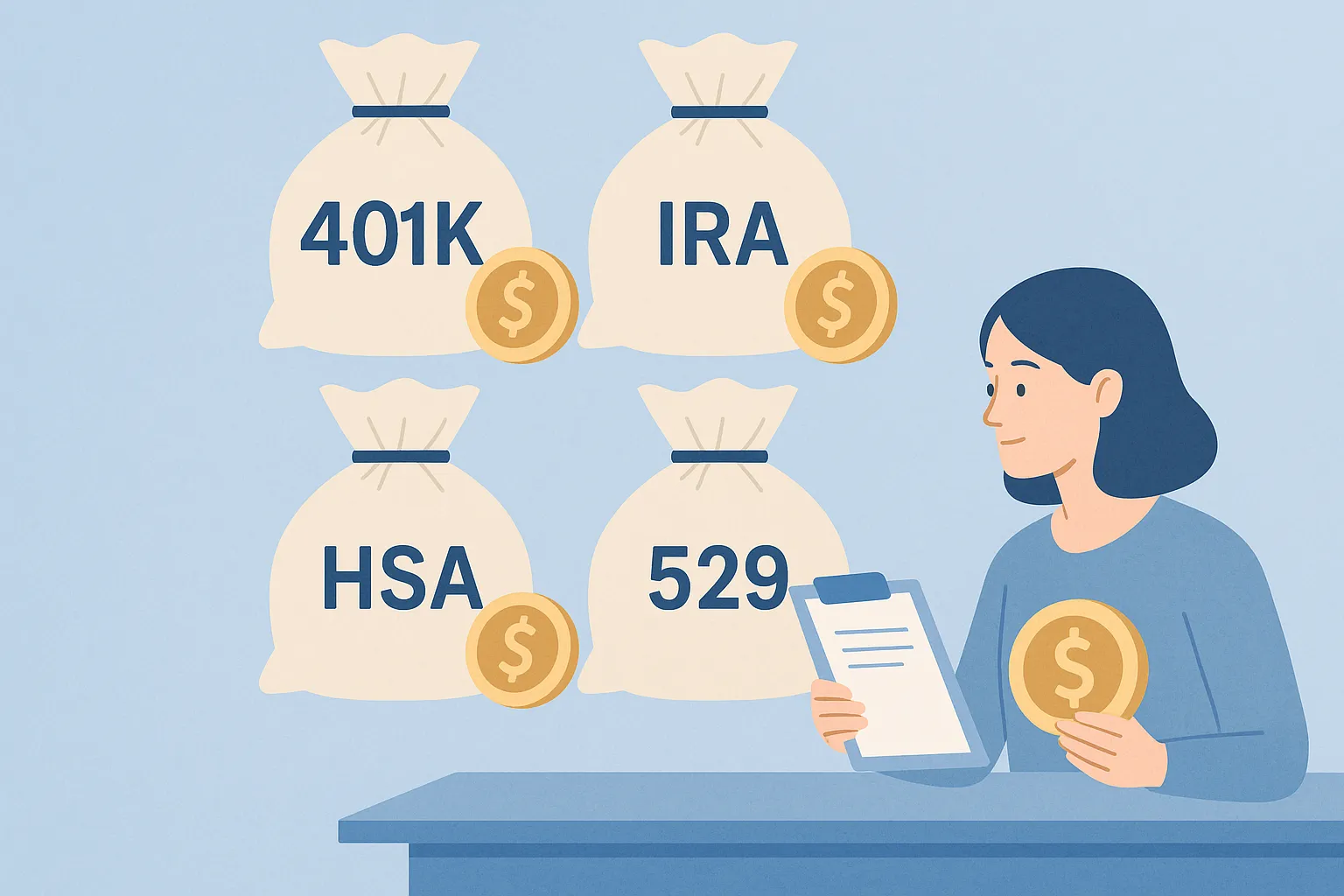
So what's the right order to fund these accounts? Here's the sequence I'd follow. First, contribute enough to your 401(k) to capture every dollar of employer match. Full stop. That's an instant 50% to 100% return on your money. Second, max out your HSA if you're eligible. The triple tax advantage is too good to skip. Third, consider maxing your Roth IRA, especially if you're in the 22% bracket or below. Fourth, go back and max your 401(k) if you have money left. Finally, if you have kids and education savings is a priority, fund the 529. This isn't a rigid law, but it's a framework grounded in where the tax math works hardest in your favor.
A few important nuances deserve attention. First, contributing to a Traditional IRA is only deductible if you don't have access to a workplace retirement plan, or if you do, your income falls below IRS thresholds. In 2024, the deduction phases out between $77,000 and $87,000 for single filers who also have a 401(k). If you're above those limits, a nondeductible Traditional IRA contribution is usually not worth it unless you're doing a backdoor Roth conversion. Second, Roth 401(k) options are increasingly common. If your employer offers one, it's worth considering, especially if you expect to be in a higher bracket in retirement.
RMDs and the long-term flexibility you're trading for today's tax break
Traditional accounts force you to take withdrawals at age 73, which can create taxable income you don't want. Roth IRAs and HSAs have no RMDs, and that flexibility is worth more than most people realize during retirement planning.
Required Minimum Distributions (RMDs) are something you can't ignore when planning your long-term strategy. Traditional 401(k)s and Traditional IRAs require you to start taking withdrawals at age 73 under current law (per the SECURE 2.0 Act). Roth IRAs have no RMDs during your lifetime, which is a meaningful advantage if you want to control the timing of your taxable income. HSAs also have no RMDs. That flexibility matters if you're doing tax planning in retirement, trying to manage Medicare premiums, or thinking about what you're passing to heirs.
Watch out for excess contributions. The penalty is real.
Exceed your contribution limits and the IRS charges a 6% excise tax every year the excess stays in the account. It's easy to avoid with a quick annual check, but the mistake sneaks up on people who change jobs or contribute to multiple accounts.
Let's talk about what happens if you exceed contribution limits. The IRS charges a 6% excise tax on excess contributions for each year they remain in the account. It's avoidable. Track your contributions, especially if you switch jobs mid-year or contribute to multiple accounts. Your payroll system and IRA custodian won't automatically prevent you from going over the limit across accounts. That responsibility sits with you. It's worth a 10-minute annual check against the IRS contribution tables to confirm you're in bounds.
Your next step: map your contributions and act today
The article is only useful if you do something with it. Pull up your current contribution rates, compare them to the 2024 limits, and move your next dollar to the account at the top of the priority list.
The best next step isn't reading more articles. It's opening a spreadsheet or using a budgeting app to map exactly how much you currently contribute to each account, compare it to the 2024 limits, and calculate where your next dollar should go using the priority order above. If you have an employer match you're not capturing, start there today. Literally today. Log into your HR portal and adjust your contribution rate. The compounding you gain by funding these accounts in the right order, starting as early as possible, is one of the most powerful forces in personal finance.